
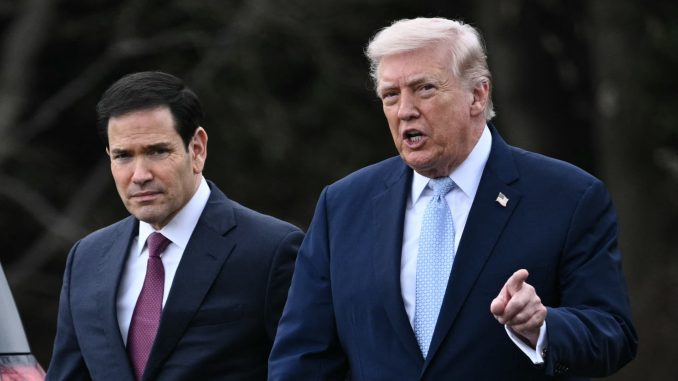
U.S. President Donald Trump speaks to the press before his departs the White House en route Miami on March 20, 2026, in Washington, D.C.
Anadolu | Anadolu | Getty Images
U.S. President Donald Trump late Saturday threatened to “obliterate” Iran’s power plants if Tehran does not fully reopen the Strait of Hormuz within 48 hours, as the war escalated in a dangerous new direction at the start of its fourth week.
“If Iran doesn’t FULLY OPEN, WITHOUT THREAT, the Strait of Hormuz, within 48 HOURS from this exact point in time, the United States of America will hit and obliterate their various POWER PLANTS, STARTING WITH THE BIGGEST ONE FIRST!” Trump said in a post on Truth Social.
The dramatic reversal came barely a day after Trump talked about “winding down” the war.
In a Truth Social post on Friday, the president claimed that the U.S. is “getting very close to meeting our objectives as we consider winding down our great Military efforts in the Middle East.”
Trump had also told reporters that he is not interested in a ceasefire with Iran.
“We could have dialogue, but I don’t want to do a ceasefire,” Trump said from the White House South Lawn before departing for Florida. “You know you don’t do a ceasefire when you’re literally obliterating the other side.”
“They don’t have a navy. They don’t have an air force. They don’t have any equipment,” Trump continued.
However, hours after Trump’s remarks, Israeli Defense Minister Israel Katz countered that Israeli attacks against Iran will “increase significantly” in the coming week.
“This week, the intensity of the attacks that the IDF and the U.S. military will carry out against the Iranian terrorist regime and against the infrastructures on which it relies will increase significantly,” Katz said in a video statement.
Iran and Israel trade strikes near nuclear facilities
Trump issued his stark warning as Iran and Israel traded strikes targeting nuclear facilities.
Dozens of people were injured after Iran struck two communities near Israel’s main nuclear research site. The Israeli military said its defenses were not able to intercept missiles that hit the southern cities of Dimona and Arad.
Israeli soldiers work at the scene of damage after Iranian missile barrages struck residential buildings in Arad, amid the U.S.-Israel conflict with Iran, in southern Israel on March 22, 2026.
Ronen Zvulun | Reuters
Initial footage from the scene in Arad showed a bus with its windows blown out and heavy damage to several buildings, and dozens of firefighters and police responding to two separate impact sites. Israel’s rescue services said four people were seriously injured, including a 4-year-old girl, and 29 were lightly injured. Authorities are still looking for several people who are unaccounted for.
It marked the first time in the war that Israel’s nuclear research center was targeted.
Israel’s secretive nuclear reactor is about 13 kilometers southeast of Dimona. Both cities lie near several military sites, including Nevatim Air Base, one of the country’s largest.
“This is a very difficult evening,” Israeli Prime Minister Benjamin Netanyahu said, adding that more emergency resources were being sent to the scene.
The strikes on Israel came after Iranian media reported U.S.-Israeli forces had attacked the Shahid Ahmadi-Roshan Natanz nuclear enrichment complex. Technical experts found that no radioactive leaks had occurred and nearby residents were not at risk.
Israel denied responsibility and said it wasn’t aware of Israeli strikes in that region.
The International Atomic Energy Agency said in a post on X that “no abnormal radiation levels have been detected” and added that it is looking into the report.
The same nuclear facility was targeted by Israel and the United States during the 12-day war with Iran in June 2025.
Meanwhile, Israel said it had attacked Tehran, Karaj, west of the capital, and the central city of Isfahan. Three members of a family were killed in a strike on a residential building in the city of Ramsar, Iranian media reported.
The death toll has risen to more than 1,500 people in Iran, over 1,000 in Lebanon, at least 60 in Iraq, 17 in Israel, 13 U.S. service members, 8 in the United Arab Emirates, 5 in Kuwait, 3 in Saudi Arabia, and 2 in Bahrain.
U.K. says Iran unsuccessfully targeted base
Iran unsuccessfully targeted a joint U.S.-U.K. military base in the Indian Ocean, U.K. officials said.
“Iran’s unsuccessful targeting of Diego Garcia was before yesterday’s update on the use of U.K. bases by the U.S.,” the U.K.’s Ministry of Defence (MoD) told CNBC in an emailed statement.
British Prime Minister Keir Starmer’s office said Friday that ministers had approved U.S. forces’ use of British bases to defend the region, including “U.S. defensive operations to degrade missile sites and capabilities being used to attack ships in the Strait of Hormuz.”
The MoD said the U.K. has given the U.S. permission to use its bases at RAF Fairford in England and at Diego Garcia in the Chagos Islands for “specific and limited defensive operations.”
Diego Garcia, a British Indian Ocean Territory and the largest of the islands in the Chagos Archipelago on July 02, 2013 in Diego Garcia, British Indian Ocean Territory.
USGS NASA | Gallo Images | Getty Images
Iran targeted the island with a two-stage intercontinental ballistic missile, Israel’s military said. This refers to missiles with at least two rocket engines, one allowing the missile to reach space, and the other propels it to its target, at a range of up to 4,000 kilometers (2,500 miles).
“These missiles are not intended to strike Israel. Their range extends to the capitals of Europe — Berlin, Paris, and Rome are all within direct threat range,” Chief of Staff Lt. Gen. Eyal Zamir said.
The Wall Street Journal first reported the attack on Friday, citing multiple U.S. officials.
“Iran’s reckless attacks, lashing out across the region and holding hostage the Strait of Hormuz, are a threat to British interests and British allies,” the U.K. said in its statement. “[Royal Air Force] jets and other U.K. military assets are continuing to defend our people and personnel in the region.”
The reported attack marked Iran’s first operational use of intermediate-range ballistic missiles and a significant attempt to reach far beyond the Middle East and threaten U.S. interests, the Wall Street Journal said.
U.S. allows sale of Iran oil at sea
The war, which began on Feb. 28 with U.S. and Israeli airstrikes against Iranian targets, has effectively choked off the narrow and economically crucial Strait of Hormuz, which separates Iran from the United Arab Emirates.
Around one-fifth of the world’s oil transits the Strait. Daily transit calls have tumbled to nearly zero from highs above 120 seen earlier this year, according to data analyzed by Charles Schwab. Much of the crude from the Gulf usually heads to Asia.
Benchmark Brent crude oil futures for May rose 3.26% to $112.19 a barrel on Friday, its highest close since July 2022. U.S. West Texas Intermediate futures for April settled 2.27% higher at $98.32 a barrel.

The Trump administration’s latest attempt to ease prices came late Friday, when it waived sanctions on the purchase of Iranian oil at sea for 30 days. The move is expected to bring 140 billion barrels of oil to global markets, U.S. Treasury Secretary Scott Bessent posted on X.
“This temporary, short-term authorization is strictly limited to oil that is already in transit and does not allow new purchases or production,” he said. “Further, Iran will have difficulty accessing any revenue generated and the United States will continue to maintain maximum pressure on Iran and its ability to access the international financial system.”
The license authorizing the sale and delivery, posted after market hours on the Treasury Department’s website, allows Iranian oil into the U.S. when necessary for its sale, delivery or offloading. Iranian oil hasn’t been meaningfully imported to the U.S. since the 1979 Iranian revolution.
G7 ready to protect global energy supplies
The Group of Seven countries are ready to take necessary measures to support global energy supplies, its foreign ministers said in a statement. They also reaffirmed the importance of safeguarding maritime routes, including in the Strait of Hormuz.
“We … express support to our partners in the region in the face of the unjustifiable attacks by the Islamic Republic of Iran and its proxies,” the ministers of Canada, France, Germany, Italy, Japan, the United Kingdom and the United States, as well as the top EU diplomat, the statement said.
“We condemn in the strongest terms the regime’s reckless attacks against civilians and civilian infrastructure, including energy infrastructure,” it said.
Iran calls for ‘immediate cessation’ of ‘aggression’
Iran’s President Masoud Pezeshkian said there needs to be an “immediate cessation” of what he described as U.S.-Israeli aggression to end the war and wider regional conflict, Iran’s embassy in India said in an X post on Saturday.
Pezeshkian spoke with India’s Prime Minister Narendra Modi by phone earlier in the day.
Pezeshkian told Modi that there should be guarantees to prevent a recurrence of such “aggression” in the future. He also called on the BRICS bloc of major emerging economies to play an independent role in halting aggression against Iran.
22 countries urge opening of Strait of Hormuz
The leaders from 22 countries — including the United Arab Emirates, the U.K., France, Germany, Japan and Bahrain — released a joint statement condemning Iran’s closure of the Strait of Hormuz, as well as its attacks on unarmed commercial vessels in the Gulf and on civilian infrastructure, including oil and gas facilities in the region.
“We express our deep concern about the escalating conflict. We call on Iran to cease immediately its threats, laying of mines, drone and missile attacks and other attempts to block the Strait to commercial shipping, and to comply with UN Security Council Resolution 2817,” the statement said.
The countries said they are ready to contribute to “appropriate efforts” to ensure safe passage through the strait.
Saudi Arabia expels several Iranian diplomats
The kingdom’s Foreign Ministry said the security attache and his assistant, along with three other staffers in the Iranian embassy in Saudi Arabia, should leave within 24 hours. Hours earlier, Saudi Arabia downed 20 Iranian drones, according to its Defense Ministry.
Earlier in the day, the Defense Ministry of the United Arab Emirates said it responded to three ballistic missiles and eight drone attacks. Jordan’s military said 240 missiles and drones have been fired at Jordan since the war began, wounding 24 people.
Egypt’s president Abdel-Fattah el-Sissi and Saudi Crown Prince Mohammed bin Salman stressed that the Iranian escalation against Gulf states endangers the safety and the stability of the region, the state-run Saudi Press Agency reported. And Arab League chief Ahmed Aboul Gheit said the visits of el-Sissi and his Jordanian counterpart King Abdullah II to multiple Gulf states over the past few days “reflect full Arab solidarity.”
Iran vows safe passage for Japanese vessels
Iranian Foreign Minister Abbas Araghchi said Tehran is ready to facilitate the passage of Japanese vessels through the Strait of Hormuz, adding that negotiations with Japan on the issue are ongoing.
Iran’s Foreign Minister Seyed Abbas Araghchi speaks at a weekly news conference in Tehran, Iran, on March 16, 2026.
Shadati | Xinhua News Agency | Getty Images
“We have not closed the strait. It is open,” Japanese news agency Kyodo quoted Araghchi as saying in an interview on Friday.
He also said that Iran is seeking “not a cease-fire, but a complete, comprehensive and lasting end to the war.”
Araghchi said Iran has not closed the strategic waterway but has imposed restrictions on vessels belonging to countries involved in attacks against Iran, while offering assistance to others amid heightened security concerns, Kyodo reported.
He added that Iran is prepared to ensure safe passage for countries such as Japan if they coordinate with Tehran.
Iranian gas to Iraq reportedly resumes
Iranian gas supplies to Iraq have resumed at a rate of five million cubic meters per day, the Iraqi electricity ministry said on Saturday, according to the state news agency.
Flows had been cut off since Israel’s attack on Iran’s main gas field, South Pars, on Wednesday.
— CNBC’s Terri Cullen, Reuters and the Associated Press contributed to this report



