
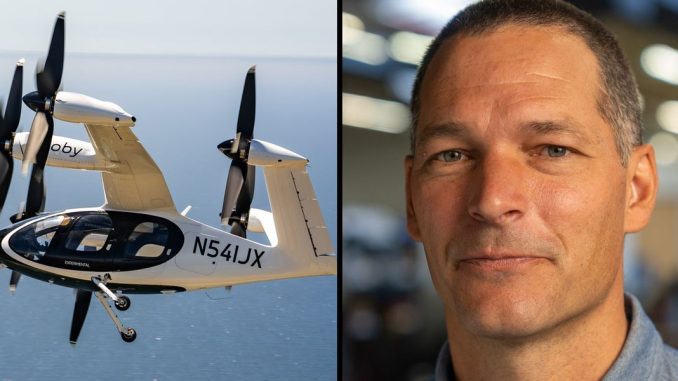
When JoeBen Bevirt founded the company now known as Joby Aviation in 2009, electric aircraft were on few people’s minds. Tesla’s first electric vehicle, the Roadster, had arrived on the market just one year earlier, and it was not yet evident that EVs would transform the automotive industry, let alone aviation. But Bevirt was convinced that he could revolutionize urban transportation with electric air taxis, also known as electric vertical take-off and landing aircraft (eVTOLs for short).
In a departure from many conventional aircraft manufacturers, Bevirt embraced a rapid, iterative, design process that Joby refers to as “design, build, and test.” According to Jon Wagner, who spent five years as senior director of battery engineering for Tesla before joining Joby in 2017, “the original concept was that the more times you go through the process, each time you can identify improvements or problems that need to be addressed. And if you have a very good system for going through that iterative process quickly and at a low cost, then you can take risk, because if it fails, you just go again.”
With no existing supply chain for electric aircraft, Joby applied this iterative design strategy to almost every component of its eVTOL, including its all-important electric powertrain. Joby cycled through several generations of a geared electric motor before Wagner joined the company, leading development of a direct-drive motor with superior reliability, performance, and noise characteristics. With Joby’s aircraft now undergoing certification with the U.S. Federal Aviation Administration, IEEE Spectrum caught up with Wagner to learn more about the company’s powertrain technology and where he expects it to go in the future. Our interview with him has been edited for concision and clarity.
What can you tell us about the design of Joby’s electric motor?
Wagner: It’s a direct-drive motor running the propeller. That direct-drive motor has a fairly large diameter in order to get the high torque density that we want. Essentially, the challenge there is, we want to spin the propellers relatively slowly compared to most aviation propellers, to reduce the sound. The trade-off there is when you spin them slowly, you need a lot of torque, and so we have a fairly high-torque direct-drive motor.
That’s arranged as a single magnet ring—the spinning part is the magnet ring, it’s well integrated onto the propeller system. The stationary portion is typically called the stator. For us it’s copper coils and magnetic steel that focuses the electromagnetic forces. That is made up of essentially two motors, so the stator is divided into two separate sets of coils, each driven by separate inverters, each sourced by separate batteries for redundancy.
At a high level, that’s the layout. The details are how you separate those coils electrically, how you separate the inverters both physically and electrically, and then, really, what stitches all of this together is a thermal system. And the thermal system is very key to achieving low weight. Essentially, when we talk about the innovation we bring, it’s typically not invention, it’s integration. We typically pick solutions that the world knows about—there’s very little here that’s PhD thesis work. It’s integration work.
How important is manufacturability in the design of your motors, and does the fact that Joby is building its motors in house change your calculus there?
Wagner: It really does. Table stakes for a good design is manufacturability, so it’s fundamental, and it was architected into the entire concept. Where the vertical integration that Joby has developed creates an advantage for us is actually exactly in manufacturability and how it pertains to performance.
In a mature industry like the automotive industry, you typically see a very diverse supply chain and a very advanced kind of outsourced supply-chain methodology. The most efficient way to run these very mature companies is to break your system up into pieces that can be outsourced to suppliers who are going to do a really good job of each piece. And that actually works really well once the supply chain is mature, and they know how to make all those parts, and also once the industry knows what they need from each part.
The downside is that when you break a problem up into three pieces, you now have interface boundaries between each of these pieces, and those interface boundaries always create inefficiencies and that typically manifests as either complexity of the design or mass or potentially introducing reliability [concerns].
Here’s where the vertical integration comes in. We were able to design highly integrated solutions without taking the manufacturing penalty that would come from finding a supply chain where they would make each part to integrate to each other. And so by having that vertical integration in our team, we essentially address the manufacturing challenges, and we get the mass and performance benefits of a highly integrated solution.
Where Superconducting Motors Could Matter
Aviation motors are a hot topic in machine design, and there’s been considerable interest in the use of superconductive or carbon nanotube coils, for example. Are you exploring any of these?
Wagner: Superconducting is a very interesting vector, and there is a lot of interesting work going on with superconducting materials. Essentially the win here is reducing the losses; losses are heat generation and energy that doesn’t turn into useful work for the airplane. And the first thing I’ll say is that motors without superconducting materials actually are quite efficient. We’re talking low to mid 90 percent efficient already. With these kinds of efficiencies, the win is somewhat small, and the effort is very high. And so we have looked at superconducting motors, but we’re not really working actively on this right now.
Where this really gets interesting is often in a larger size, so bigger scale. We live in the hundreds of kilowatts scale. When you get to the multiple megawatts kind of scale, one to 10 megawatts, for motors in that size, there could be some big advantages. Five percent of 10 megawatts ends up being a lot, and so you could potentially get big gains there.
There are challenges. The challenges with superconducting motors are that you need to get them very cold in order to maintain the superconducting features. And then if you want to take advantage of that superconducting performance, you essentially have a motor that if you lose the ability to keep it cold, it has almost no productive use. So in other words, it was never designed to work when it isn’t superconducting, and therefore your cryogenic cooling system, if there’s any failure in that system, you essentially cannot produce any power anymore, and so you end up being very reliant on the cryogenic cooling system. Potentially even the motor could fail very rapidly after a failure of the cooling system.
These are solvable problems, but they bring challenges, and that’s part of the reason why I think that we’ll see this first with the largest motors.
How do you expect to Joby’s powertrain solutions to evolve in the future, balancing the availability of new technologies and materials against the difficulty of certifying new designs?
Wagner: We essentially set out more than 10 years ago to build an airplane that demonstrates a shift out of fossil fuels, and the best way to do it at that time—and it turns out, still now—is with batteries. And so we’re now at the late stages of development into the certification, in the stable-design state. We essentially know it’s going to work, right? And that’s very exciting, because I think what we’ll see from here as we branch forward is continual improvement in batteries.
We know that battery energy density is a huge problem. It’s very heavy for the amount of energy stored. It’s much worse than for fossil fuels, so right now, and probably well into the future, battery-based energy storage for aviation has somewhat limited market potential. We don’t really see batteries being able to handle long-haul. Those kinds of trips that most of us utilize, I don’t think we’ll see battery energy storage for those anytime in the near future.
It’s no secret that Joby has a very active effort going with hydrogen as the primary energy source. We’ve been doing that for many years. We look at taking hydrogen and using fuel cells to convert that hydrogen to electricity and then essentially using the same electric propulsion system downstream. We think that’s a very exciting direction, both for regional transport and long-range transport, but especially for long-range transport, really the best solution.
There are challenges that we’re actively working to solve. Number one, how do you store the hydrogen? Number two, how do you refuel and what does the ground infrastructure look like to get that source of fuel from the source of hydrogen onto an airplane? And then, number three, how do you convert that hydrogen to electricity? Based on what I see, the future of aviation absolutely comes down to storing energy, and hydrogen is fundamentally, at a molecular level, about three times better than fossil fuels at storing energy per mass. And that’s a really big deal.
The opportunity is so big on hydrogen, when you have three times better on something like the storage density, it means that it’s worth putting a lot of research into how to make this work, because that’s going to pay off at the very end. And so we’re firmly in it for that. I’m very excited about that future, which yet may be decades off, but has to start somewhere.
From Your Site Articles
Related Articles Around the Web



