
As more AI data centers come online, concerns are rising about their effects on the grid, and it’s not just the amount of power they consume. They tend to have huge swings in power use, surging up and down by 70 percent or more in milliseconds. Traditional electricity infrastructure isn’t designed to deal with that kind of load fluctuation.
To address the problem, researchers are developing power electronics systems that sit between the data center and the grid to act as a buffer and even a grid helper in times of need. One such system, developed by Miami-based ON.energy, is being implemented across 3 gigawatts of projects, and has sailed through a battery of tests at the U.S. National Lab of the Rockies (NLR).
In the tests, ON.energy’s system protected a simulated data center from simulated grid instability events and vice versa, including successfully safeguarding the grid from the major load swings generated by the data center. The company’s technology involves a bi-directional uninterruptible power supply (UPS) that it calls AI UPS.
Such grid buffers are becoming increasingly important as AI facilities expand to gigawatt scale and beyond. Utilities have major concerns about both the amount of power demanded by these data centers and their potential to create system instability due to wild variations in load. Innovations are needed to help data centers become better grid citizens, and shorten the amount of time they must wait to connect to the grid.
AI Data Centers and Grid Stability
UPS systems have been used for decades to protect data centers from grid events. If frequency varies suddenly or power is lost, these uni-directional systems provide almost instantaneous, short-term backup power to the equipment inside the data center. Because servers can’t tolerate more than minor deviations, UPS electronics also clean up low-quality power such as voltage spikes or sags and frequency deviation.
UPS has served data centers well. But the scale of modern facilities packed with graphics processing units (GPUs) changes the game. Instead of data centers being sized in tens of megawatts, AI facilities are reaching up to 5 GW. They still require the type of protection afforded by UPS, but their massive scale and load volatility pose dangers to the grid.
During a minor grid fault in Virginia in 2025, for example, several data centers tripped offline, causing 1.5 GW to drop off the grid simultaneously. This caused panic for the system operator who had to act fast to balance the system and avoid a major power outage.
In addition to major changes in overall load, AI data centers can generate short-lived, high-voltage or high-current disturbances known as grid transients. They may only last microseconds, but they can break down insulation, overheat transformers, cause electrical arcing, start fires and destabilize an entire grid.
“The scale of modern data centers could lead to load swings of 1 GW multiple times per minute, which creates frequency variations and oscillations that the grid can’t handle,” says Ricardo de Azevedo, CTO at ON.energy.
These problems have given utilities and government authorities pause. Some authorities in the U.S. and parts of Europe are implementing moratoriums on new data centers or instituting rules that place responsibility for grid conditions onto the data center.
Texas Senate Bill 6, for example, requires new data centers to pay a share of any new grid infrastructure needed by their facilities. Additional requirements for voltage ride-through—the ability of equipment to continue operation during power disruptions—are currently being formulated in accordance with this bill. Such rules aim to prevent large data centers from tripping offline suddenly or overwhelming the grid due to severe load variability from AI workloads.
“One of our customers in Texas that is building a 1-GW campus is now being required by the local grid authority to include voltage ride-through,” Azevedo says.
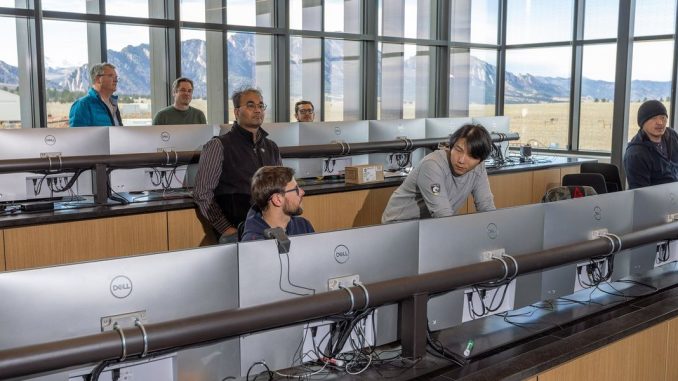
NLR engineers Przemyslaw Koralewicz (left) and Shahil Shah monitor the results of a simulation of ON.energy’s AI UPS in the control center at the NLR Flatirons Campus.Agata Bogucka/NLR
Bi-Directional UPS
ON.energy’s 3.5-megawatt units consist of a power conversion system (PCS), batteries to store energy and act as an energy reservoir or buffer, another PCS, and a transformer. The batteries can provide up to eight hours of backup power, depending on the size of the data center. ON.energy sources this equipment from established manufacturers and adds its own software and controls.
The latest PCS units are designed to be bi-directional, acting as the interface between the grid and batteries. They protect the data center, convert electrical energy between the AC provided by the grid and DC needed by data center equipment, and ensure quality and optimal flow when charging batteries or feeding power to an AI facility. In the other direction, the batteries can absorb and smooth out any transients generated by sudden load swings in the data center that can disrupt the grid.
“The batteries act like a reservoir of energy as well as a shock absorber should there be any disturbances on the grid or from the data center,” says Azevedo.
ON.energy’s system is housed outside the data center, rather than inside like most UPS systems, which frees up space internally for more compute resources. Being outside also allows it to harness more advanced power electronics fed by medium voltage. Traditional UPS, on the other hand, operates on the low voltages needed by data center computers for safety reasons.
The company has about 3 GW of these bi-directional AI UPS units either operating or under construction. It expects to commission a system in May for a 1.5-GW AI data center in Texas, according to Azevedo. For such a facility, hundreds of these 3.5-MW units would be required.
NLR’s Data Center-Grid Simulator
To test its system, ON.energy turned to NLR (formerly known as the National Renewable Energy Laboratory). The facility is likely the only one in the world that can do full-load, bi-directional testing that simulates both grid conditions and variable data center loads. The facility can test up to 20 MW with voltage levels reaching 13.2 kV. The test consisted of a 7-MW grid simulator that replicates disturbances and voltage ride-through events, and a 20-MW load simulator that reproduces real-world demand dynamics such as those created by an AI data center.
Systems like ON.energy’s could become the norm in the coming years. Pilot projects for similar technologies are ongoing in Ireland. Another project in France coordinated by the Electric Power Research Institute (EPRI) is assessing the capabilities of UPS systems through its DC Flex initiative. Results are expected in the coming weeks. Lower voltage versions of this type of bi-directional technology are also under development by Eaton and Microsoft.
From Your Site Articles
Related Articles Around the Web



