
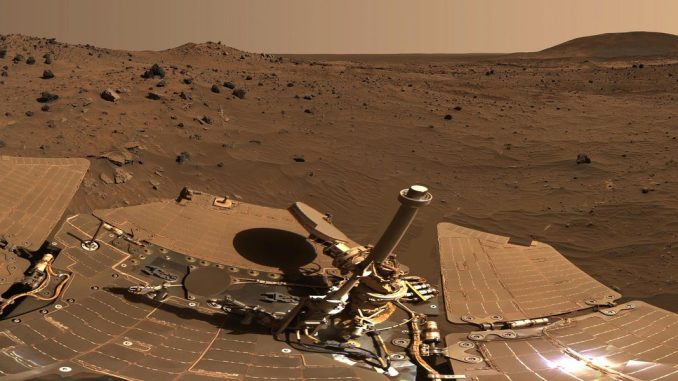
Rover data from more than 20 years ago has revealed clues to the existence of liquid water on ancient Mars. NASA’s Spirit rover carried a specialized instrument called a Mössbauer spectrometer that performed mineralogical analyses of soil, rock, and dust on the surface of the red planet at Gusev Crater.
Individual measurements didn’t always indicate definitive proof of water, but when scientist Paolo de Souza of Edith Cowan University in Australia examined years’ worth of measurements together, a definite pattern began to show up in the existence of minerals that could only exist in the presence of water. His analysis shows that Mars used to sport a lot more water than scientists expected.
De Souza was particularly interested in the existence of hematite and altered magnetite measured in the Martian soil. These two minerals often form when rocks interact with water. Hematite, in particular, is at the heart of the amazing “blueberries” found on Mars at Meridiani Planum by the Opportunity rover. The traces of hematite in de Souza’s study were excavated from 32 Gusev soil sites that were undisturbed. The result of de Souza’s work is the most detailed iron-mineral profile of Martian soil done to date. Scientists didn’t expect to find hematite in the soils at the site, so the finding was a surprise. It turns out it was there all along, just in amounts too small in each rover sample measurement.
“One of the most important discoveries was finding crystalline hematite in ordinary Martian soil,” Professor de Souza said in a statement. “This mineral’s widespread presence suggests not only that water was present, but that significant areas of Mars may have once been covered by water.”
SUBHEAD 1
Hematite is what’s called an iron oxide. It forms in the presence in liquid water, as well as in volcanic regions. On Mars, both types of environments exist, but the regions where the hematite is found appear to be largely shaped by past contact with water. That’s why de Souza and others suspect that these areas of Mars were once inundated with water.
Magnetite occurs in both igneous (volcanic) rocks as well as in sedimentary rocks here on Earth. It’s also an iron-bearing mineral, and on Mars, its presence indicates that water and rocks interacted. The fact that it’s also found in widespread areas indicates a warmer, wetter past on Mars.
When hematite interacts with water, it forms “blueberries”—the small, spherical nodules in this 5-centimeter sample of rock imaged by the Opportunity rover.JPL-Caltech/Cornell University/USGS/NASA
The layers of dust that the rover studied in Gusev Crater that contain traces of the water-related minerals are found across the planet. De Souza’s findings suggest that the layer of dust extends across huge areas of Mars. It likely formed over millions of years thanks to constant wind erosion, temperature changes, and storms that moved huge quantities of dust across the Martian surface.
According to de Souza, each rover measurement wasn’t enough to come to a definitive conclusion about water on Mars. But, taken together, they paint a striking picture of Mars’s past. “Many measurements were not detailed enough on their own to identify minerals present in very small quantities,” he said. “By bringing the data together and analyzing it in a new way, we were able to reveal information that had been hidden for years.”
It took de Souza several years of painstaking work, sifting through all the measurements, to construct the picture of water on Mars, particularly at Gusev Crater. He had to take into account a number of factors at play during the measurements, including temperature conditions, samples from different soil regions, physical and chemical weathering of the surface materials, and the effects of millions of years of global dust storms. He described the details in a paper published on 26 June in Interactions.
In the future, de Souza will do a similar analysis of data from soils studied by the Opportunity rover at Meridiani Planum. If it works out as expected, hundreds of measurements will be analyzed and combined to form a “big picture” assessment of water on Mars in that region as well. The work on the Gusev Crater and Meridiani Planum soils also points out the need for future missions to the Red Planet to carry spectrometers to do longer-term studies of the soil than the Opportunity and Spirit instruments were able to do.
From Your Site Articles
Related Articles Around the Web



