
A fusion start-up on a shoestring budget hopes to leapfrog more established companies by reviving a technology that’s been sidelined for half a century.
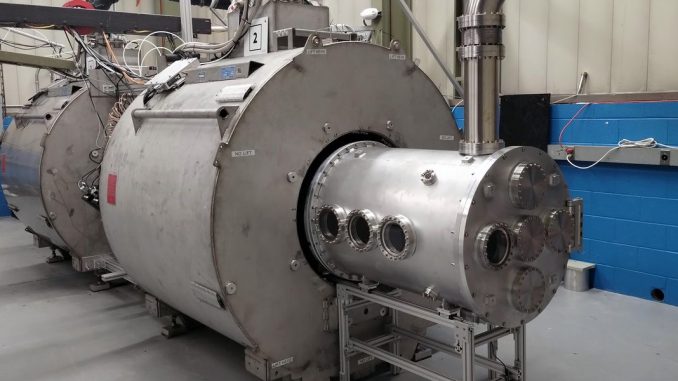
The start-up, Terra Fusion in Baltimore, is developing a reactor that uses a relatively simple approach known as magnetic mirrors to confine hot plasma–the environment where fusion reactions can occur. The company is testing its strategy on an experimental reactor at the University of Maryland, built with parts from second-hand MRI scanners and re-purposed brewing equipment.
The goal is to eventually provide a route to commercial fusion at a fraction of the cost of competing systems, says Carlos Romero-Talamas, CEO at Terra Fusion. To that end, the company is developing a more powerful proof-of-concept device that aims to exceed scientific breakeven, where a reactor generates more power than is used to heat and confine the plasma inside it.
It’s a key step towards the ultimate goal of generating useful amounts of carbon-free energy. More than 50 fusion companies around the world are working toward that goal, and over the last year, have attracted a record $4.5 billion in new funding, surpassing government spending on the technology for the first time.
Most of that money is going to large organisations working on technologies that appear closest to breakeven. These include giant toroidal tokamaks and pulsed laser systems. But that doesn’t mean it’s too late to try a different approach, says Jason Cassibry, professor of mechanical and aerospace engineering at the University of Alabama in Huntsville, and an advisor to several fusion start-ups.
“Magnetic mirrors have the advantage of being simple,” he says. “If a nation or company wants to be first and have the highest power density, they might go with a tokamak. But if they want something that’s cheaper to build and easier to maintain, they might go with a mirror concept.”
Terra Fusion is now in a race to demonstrate a bargain-basement reactor before its mainstream rivals.
How do magnetic mirrors confine plasma?
Building a nuclear fusion reactor is an attempt to bottle the same reaction that powers the sun. The tremendous gravitational force within stars propel hydrogen nuclei to fuse together into helium, releasing vast quantities of energy in the process. Scaling that down to a reactor on Earth requires either confining an incredibly hot plasma with magnetic fields or compressing and heating targets filled with fuel, in both cases usually deuterium and tritium. Decades of fusion experiments pushing the limits of magnet, laser, and materials technologies have shown just how difficult that is.
Magnetic mirrors are a particular configuration of natural or artificial magnetic fields that can trap energetic particles for long periods. They can be found in the Earth’s Van Allen radiation belts, for example, which can capture electrons and protons from the sun for years, causing hazards to spacecraft and astronauts travelling between 1,000 and 60,000 kilometers in altitude.
During the Cold War, researchers used traditional electromagnet coils at each end of a vacuum chamber to form magnetic mirrors on Earth. The hope was that the mirrors would confine hydrogen nuclei within a plasma for long enough for them to be heated to the point of fusion.
But those efforts failed. The plasmas proved unstable and the mirrors were leaky, allowing energetic particles to escape. When the world’s largest and most expensive magnetic mirror reactor was mothballed at Lawrence Livermore National Laboratory the day after being completed in 1986, magnetic mirrors appeared to be a dead end. Enormous donut-shaped tokamaks seemed to offer a smoother path to fusion breakeven.
But some mirror research trickled on. At the University of Maryland, engineers were intrigued by earlier experiments that suggested that the magnetic mirror strategy could work if the plasma was rotated at supersonic speeds. This could stabilize the plasma and reduce leaks. From 2004 to 2010, Romero-Talamas, who was a postgrad student at the time, and other researchers operated this kind of reactor, called the Maryland Centrifugal Experiment, that gave some impressive results.
“With only a few megawatts of power input, we were getting similar [temperature] results to the Livermore tokamak with hundreds of megawatts,” he says.
Nuclear Fusion Startups Seek Breakeven Power
In 2010, the University of Maryland applied for U.S. Department of Energy funding for a larger magnetic mirror device, but was unsuccessful. Tokamaks were in vogue, particularly the gargantuan ITER reactor being developed by China, the European Union, India, Japan, Russia, and South Korea and the United States.
It was not until 2020 that Romero-Talamas, now an associate professor, secured a major grant: $5.2 million grant from ARPA-E (the U.S. federal government’s Advanced Research Projects Agency–Energy). The sum was a tiny fraction of the more than $1.5 billion the U.S. had already spent on ITER (now nearing $3 billion), but it would be enough to build a reactor, dubbed the Centrifugal Mirror Fusion Experiment (CMFX), if Romero-Talamas was frugal.
As with many fusion reactors, CMFX’s priciest components would be its superconducting magnets. Instead of buying them brand-new, Romero-Talamas repurposed them from two Philips medical MRI scanners by stripping out the scanners’ patient beds, scanning coils, and plastic cases. He also modified glass beer bottles for use as insulators, and acquired some donated equipment from the Air Force Research Laboratory. The Maryland Space Grant Consortium paid for summer interns to work on the project.
Although the scanner magnets could generate the strong 3 Tesla magnetic fields CMFX required, the cavity for human patients around which they were designed was larger than Romero-Talamas had planned for, forcing a redesign of the reactor.
Inside the CMFX reactor, rotation begins [top left] and the plasma is still relatively cold, indicated by brighter light. The plasma starts heating up [top right] as it supersonically rotates. As the plasma reaches its highest temperatures (about 10,000,000 Kelvin) the camera struggles to capture any light [bottom]. Artur Perevalov
The team designed CMFX with a central electrode running through the vacuum chamber between the mirrors that operates at a voltage similar to power transmission lines. The interaction of the electric and magnetic fields drives a plasma of deuterium ions to rotate around the electrode at well over a million meters per second, creating a centrifugal force that balances the plasma and magnetic pressures. The faster the plasma spins, the tighter and hotter it burns.
Results published last year confirmed that rotating the plasma suppressed the worst instabilities, reduced particle losses, and helped heat the plasma. At its best, CMFX reached about one-tenth of the numbers needed for thermonuclear fusion in each of temperature, density, and plasma confinement time.
“You might say, wait, you’re still a factor of a thousand away just from breaking even,” says Romero-Talamas. “But this is a huge achievement. The machine performed exactly as we designed it, which is very unusual in plasma physics where usually everything goes wrong.”
The oversize bore of the MRI magnets even helped in the end, as the larger vacuum chamber made it easier to control impurities in the plasma. In 2024, Romero-Talamas felt confident enough to take a sabbatical from the university and form Terra Fusion.
Is Terra Fusion’s Reactor Scalable?
The young company is part of a recent resurgence in interest in magnetic mirrors, says Cassibry. “The magnetic mirror seems to be on the upswing. New concepts are coming out because the tools to analyze them in detail require very robust computational models, and we just have the tools now,” he says.
There are now mirror start-ups based in India and Sweden, and another ARPA-E funded university spin-out in the U.S.: Realta Fusion, which emerged from the WHAM reactor at the University of Wisconsin-Madison. WHAM’s larger $10 million federal grant was enough for two custom-made magnets that use high-temperature superconducting (HTS) tape to generate a massive 17 Tesla field.
With the powerful magnetic field doing most of the confinement, WHAM, which stands for Wisconsin HTS Axisymmetric Mirror, only has to spin the plasma just enough to avoid instabilities. That means Realta can avoid putting electrodes in the burning heart of the reactor as Terra Fusion does. “That thing’s going to get chewed up in a power plant,” says Realta’s chief science officer, Derek Sutherland. “We think our approach is a much lower risk path.”
Terra Fusion’s first milestone is to build a proof-of-concept reactor called TFEC-1 (Terra Fusion Energy Corporation 1), using 10 Tesla magnets and a conductor operating at ten times the voltage of CMFX. TFEC-1’s ambitious 2029 timeline to breakeven is similar to better-funded rivals like Commonwealth Fusion Systems and Helion Energy.
In Terra Fusion’s favor the centrifugal mirror reactor will be much cheaper to build, says Romero-Talamas. “Our machine is much, much simpler, and a lot more straightforward in the engineering sense,” he says.
For example, Terra Fusion will eschew the latest high-temperature superconductors for magnets that need to be refrigerated close to absolute zero. This is older technology that’s available from a wider range of vendors at a much lower cost.The next step for the company is to build a production prototype.
Cassibry thinks that both Realta and Terra Fusion’s magnetic mirrors show promise. “Most likely the scaling suggests that confinement and stability will persist all the way up to breakeven,” he says. “But whenever you build something, it’s always very humbling because there’s some piece of physics that you didn’t see coming.”
Ultimately, Terra Fusion hopes to be able to sell small, modular fusion reactors in the mid-2030s, generating up to 100 megawatts to power data centers, cargo vessels, and spaceships. Realta is shooting for a 50-MW reactor in a similar timeframe that would be used in industrial processes that require intense heat, like concrete and steel production.
In the meantime, Terra Fusion’s demonstration reactor could be used to produce valuable medical isotopes, or as a test bed to develop neutron-resistant materials for rivals, Romero-Talamas says. The conductor that his team is developing to withstand the reactor’s harsh environment could also translate to more efficient and durable electrodes in industrial electric arc furnaces, potentially opening up another revenue stream.
“If I thought there was a better machine or a better concept to work on, I would be working on that right now,” says Romero-Talamas. “But I truly think that this is the way to get to scalable net energy.”
From Your Site Articles
Related Articles Around the Web



Be the first to comment