
This article is part of our exclusive IEEE Journal Watch series in partnership with IEEE Xplore.
Garlic can pack a punch, awakening our tastebuds with a real zing. Who knew that it can also be used to generate shockingly high voltages? At least, the peels of garlic do.
In a recent study, researchers in India used garlic peel and plastic to create a novel self-powered sensor and demonstrated how it could be used as part of a real-time home security monitoring system. A single layer of garlic peel folded within polyethylene proved to be a durable power source even after six months in storage.
The results, published 20 August in IEEE Sensors Letters, demonstrate how biowaste can be repurposed for simple, low-cost technological solutions.
The sensor is a type of triboelectric nanogenerator, in which two different materials—one positively charged and the other negatively charged—are layered together. When movement or pressure causes the surfaces to repeatedly contact and separate, this produces an alternating current that can be harvested or used directly as a sensing signal.
“It’s a simple, low-cost way to convert everyday mechanical motion—footsteps, vibrations, a door opening—into usable electrical output,” explains Deepak Bharti, an assistant professor in the Department of Electronics and Communication Engineering at the Malaviya National Institute of Technology, in India, who conducted the study with Ph.D. candidate Manas Tiwari.
Why use garlic peel as a voltage source?
In past studies Bharti and Tiwari have explored the use of other biowaste products for powering tech solutions, such as peanut skin and the dry, pulpy residue of sugarcane. In their most recent study, they focused on garlic peel for a number of reasons.
“Garlic peel is an agricultural and household biowaste that’s produced in large volumes, but almost never repurposed—it typically just gets thrown away,” Bharti explains. “We were interested in whether a material like this, which is lightweight, biodegradable, and widely available, could perform competitively as a triboelectric layer, instead of relying on synthetic polymers.”
He adds that, structurally, garlic peel has a naturally textured, layered surface that the researchers found favourable for contact electrification.
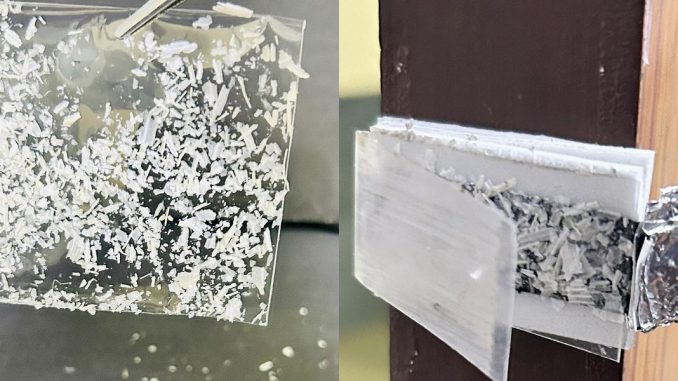
In their study, they ground up garlic peel, which is positively charged, and layered it over a negatively charged sheet of polyethylene.
A single layer of garlic peel and plastic together produced an open-circuit voltage of about 210 V and a very low short-circuit current of about 45 microamperes, with a power density of 2.16 W/m². When the researchers added an additional layer of garlic on the other side of the polyethylene sheet, this roughly doubled the output, to about 400 V and 65 µA. The combination of high voltage and low current is characteristic of this class of nanogenerators, which makes them suitable for low-power sensing devices and energy harvesting.
Bharti says he is not only surprised at how the second layer of garlic peel nearly doubled the output, but also how durable the garlic peel proved to be as a power source—maintaining its performance after six months of storage and 200 mechanical stress cycles.
“Seeing the device perform essentially the same after six months of ambient storage was a strong validation that a ‘waste’ material like this can hold up as a practical sensor material, not just a lab curiosity,” he says.
The researchers tested their sensor as a home security system, detecting when a door is opened. Manas Tiwari and Deepak Bharti
Demonstrating a home security system
The researchers then incorporated their novel garlic peel sensor into a home security system, whereby the sensor is sandwiched between the top of a door and the door frame. When the door is opened, the garlic peel and plastic layers separate, triggering a voltage spike that is relayed to a microcontroller and Bluetooth module. (While the garlic peel sensor requires no external power source, the microcontroller in this experiment uses a power bank.)
The Bluetooth module wirelessly transmits the signal to a smartphone running on a custom Android app that the researchers built. The app then generates a real-time, voice-based alert notifying the resident that the door has been opened.
Over the course of 50 tests, the sensor system was able to identify when the door was being opened with 92 percent accuracy.
Bharti says in future work he is interested in studying a curious phenomenon that occurred in these experiments. While stacking two layers of garlic and polyethylene doubled the electrical output, stacking more than two layers did not yield significantly greater outputs. Bharti plans to study this phenomenon in more detail, along with other biowaste materials that could prove useful as triboelectric materials.
From Your Site Articles
Related Articles Around the Web



Be the first to comment