
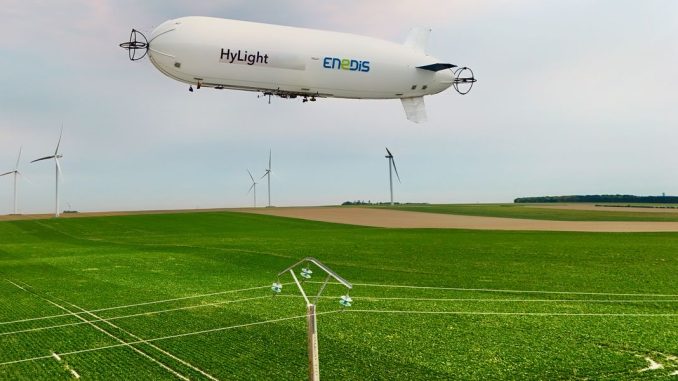
Inspecting thousands of kilometers of power lines, pipelines, or rail tracks is an expensive and time-consuming business. It’s typically done by helicopters, which are costly, noisy, and polluting. French startup HyLight thinks uncrewed airships could be a cheaper, more environmentally friendly alternative.
The company has developed a 12-meter-long blimp powered by a hydrogen fuel cell capable of staying airborne for up to 10 hours and traveling 350 kilometers per day. The airship carries an array of sensors for inspection, including high-precision cameras, lidar, and methane detectors. HyLight uses AI models (some developed in-house, some off the shelf) to automatically analyze collected data and identify more than 50 types of maintenance issues.
The French civil aviation authority and the European Union Aviation Safety Agency have both granted permission for HyLight’s airships—which have so far logged more than 750 flight hours—to operate beyond visual line of sight. The company’s fleet of four HyLighters is already carrying out inspection missions for several customers, including Enedis, France’s largest energy distributor, and SNCF Réseau, which manages the country’s rail infrastructure. And the company recently raised €13 million (about US $14.5 million) to expand its fleet, with plans to fly 15 airships simultaneously in 2027.
Cutting the Carbon Footprint of Infrastructure Inspections
Currently, this kind of inspection work is done by helicopters, says Martin Bocken, CEO of HyLight. But helicopters require multiple crew members to pilot, navigate, and survey, and they are expensive to purchase, maintain, and run. They also emit up to 1 metric ton of CO₂ equivalent per flight hour. HyLight’s airships will be cheaper to run by roughly a factor of 50 and produce significantly less carbon emissions, he says.
The HyLighter’s balance of range, cost, safety, and data-gathering capabilities could have broad applications, including environmental monitoring and urban planning. But the company thinks its initial bet on infrastructure inspection will keep it busy for the foreseeable future. “There’s 80 million kilometers of critical infrastructure in the world,” says Bocken. “It’s like 200 times the distance between the Earth and the moon to inspect. So if we keep this focus, we will have work for the next 10 to 20 years.”
While HyLight’s airship looks superficially similar to the zeppelins of yesteryear, the design has had some significant updates. Its diminutive size means that it fits in the back of a 12-wheeler truck, and thanks to its helium-filled body, it weighs just 2 kilograms. That means one person can deploy it in a couple of minutes from the side of the road rather than from an airfield, says Bocken.
The vehicle has a top speed of 70 kilometers per hour. Gyroscopic motors at the front and rear can be oriented in any direction, providing vectored thrust to precisely steer the vehicle. Control algorithms enable the vehicle to react instantly to gusts of wind, which have long been the bane of lighter-than-air vehicles. “That was the key thing that stopped airship technology being deployed at scale: the ability to control it very precisely and face high winds and wind gusts,” says Bocken.
This means the airship can handle wind speeds of up to 45 km/h, but the company also uses weather forecasts to plan inspection routes that take advantage of wind direction rather than fighting against it. Flight paths are planned in advance and followed autonomously by the airship, though a human pilot monitors missions from a control room in Paris and can step in if things go off track. Bocken says the long-term ambition is to go fully autonomous.
A HyLighter can carry up to 10 kg of sensors, including cameras that deliver imaging at a resolution of 1 millimeter per pixel at an altitude of 25 meters, lidar with a density exceeding 1,000 points per square meter, and a laser-based methane detector for inspecting pipelines. Data from these sensors is fed directly into AI models trained on anomaly detection that identifies maintenance issues such as vegetation encroaching on power lines or broken insulators.
Airships Versus Drones in Infrastructure Inspection
The application that HyLight is targeting makes a lot of sense, says Dan Grossman, an aviation historian and airship expert, although he’s unfamiliar with HyLight’s technology specifically. There have been multiple attempts to resurrect the airship since its heyday at the start of the 20th century, often inspired by romantic visions of luxury travel. But competition from faster, cheaper options like budget airlines and high-speed rail mean that’s little more than a pipe dream, he adds.
Infrastructure inspection is exactly the kind of boring but highly practical application that modern airships excel at, Grossman says. The main challenge for airships is high winds, but Grossman agrees HyLight should be able to schedule routine inspections around the weather.
There is another emerging technology muscling in on the infrastructure inspection space that could potentially provide HyLight with competition: drones. But Bocken is not overly concerned. A typical quadrotor can only cover about 30 km a day, he says, so he’s confident the range of HyLight’s airships will make them a cheaper and faster option.
However, Emad Samuel Malki Ebeid, an engineering professor at the University of Southern Denmark, says drones have advantages of their own. “A multirotor drone can approach a tower or conductor from different directions, take closer looks, and position a sensor close to a specific component if needed direct inspection,” he says. “With an airship, this kind of close and agile inspection is more challenging.”
Ultimately, he thinks the two technologies could be complementary, with airships surveying long stretches of infrastructure to identify areas requiring attention that can then be inspected in detail by smaller, more agile drones.
From Your Site Articles
Related Articles Around the Web



Be the first to comment