
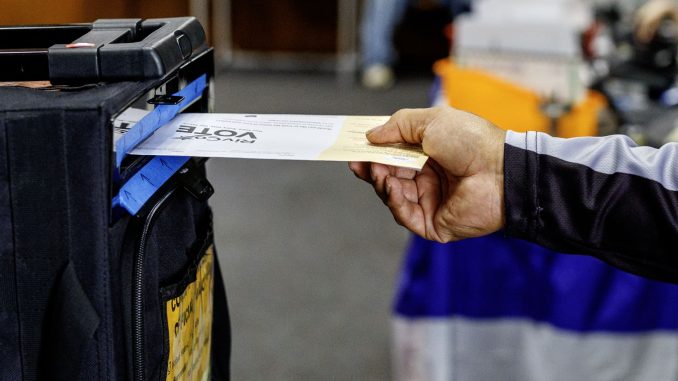
A voter drops his ballot in a secure ballot box during early voting at La Sierra Library on October 30, 2026 in Riverside, CA.
Gina Ferazzi | Los Angeles Times | Getty Images
The Supreme Court, in an order Monday evening, denied the Department of Justice’s last-minute request to temporarily block California from counting mail-in ballots from about 20,000 voters who it suggested may not be U.S. citizens.
The one-sentence order came hours after the DOJ sought the injunction, and on the eve of Election Day.
The Supreme Court did not explain its reason for the denial, which had no noted dissents. The order came after Justice Elena Kagan presented the DOJ’s request to the full court, which did not seek a response from California officials before issuing the decision.
The swift ruling is yet another courtroom blow to the Trump administration, which is engaged in multiple other legal fights related to the midterm elections.
Those contests will determine which political party holds majorities in the House and Senate. Pollsters and analysts widely predict Democrats will make significant gains.
The DOJ’s application to the Supreme Courit came three days after the 9th Circuit U.S. Court of Appeals rejected the department’s attempt to overturn a federal district court judge’s ruling that allowed the California ballots to be counted.
That same day, another federal district judge in a separate case in California barred DOJ from threatening election workers with criminal prosecution for refusing to stop processing ballots or resisting other demands.
Solicitor General D. John Sauer, in his application to the Supreme Court on Monday morning, said, “In this case, this Office has been informed that the United States has identified more than 20,000 individuals who appear to be registered to vote in California based on publicly available information at the time that information was received, but who, in the United States’ view, are likely not U.S. citizens.”
Sauer said “the United States is likely to succeed on the merits of its appeal” of the lower court ruling denying the DOJ’s request.
“The district court concluded that the United States lacks Article III standing to bring this suit, but the United States suffers a judicially cognizable ‘injury to its sovereignty’ from the ‘violation of its laws,'” Sauer said in the petition. “Once California commingles the challenged ballots with lawful ones, there is no way to get the challenged ballots back.”
The DOJ sued California on Oct. 15 in U.S. District Court in Los Angeles. The complaint sought to prevent state election officials from tabulating mail-in ballots “from likely non-citizens in the upcoming federal election until the voter’s citizenship status can be determined.”
The DOJ previously gave Los Angeles County officials a thumb drive containing names of voters the department suggested could be noncitizens, who by law are barred from voting in federal elections.
Last Wednesday, Judge David Carter denied the DOJ’s request that he order California officials to set aside mail ballots from alleged noncitizens named on a list prepared by the Department of Homeland Security, and not count their votes until their citizenship is confirmed.
“This case is about the right of every American citizen to vote in a free and fair election,” Carter said in his ruling.
“Never before in American history has the federal government, on the eve of an election, sought to coerce a state and local government to abandon their own Constitutional elections procedures and bend to the will of the Executive Branch,” Carter wrote.
“In bringing this lawsuit, the Executive would have this Court believe that it reigns as a sole sovereign. But California and its people are sovereign, too.”
The DOJ then appealed that ruling to the 9th Circuit. A three-judge panel on that court denied the appeal in a 2-1 ruling on Friday
“There is a material risk that granting the United States its requested relief would result in disenfranchisement,” said the ruling by the majority, Circuit Judges Mark Bennett and Gabriel Sanchez. Bennett was appointed by President Donald Trump, and Sanchez was appointed by former President Joe Biden.
On Sunday, a federal judge dismissed a DOJ lawsuit that sought to block Alaska election officials from immediately certifying the result of the U.S. Senate election there if incumbent Republican Sen. Dan Sullivan loses that race by a margin that could be attributable to voter confusion about another candidate with his name.
The DOJ is appealing that ruling.



Be the first to comment