
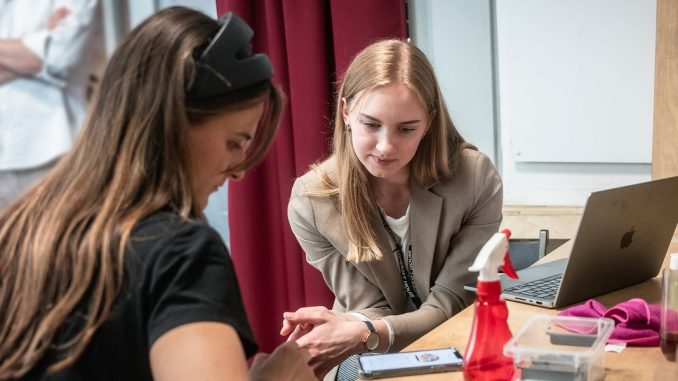
Most women report menstruation-related pain or mood changes, and for around one in five women, strong symptoms disrupt daily life. Standard treatment options tend to focus on hormonal regulation, pharmaceuticals for mood stabilization and pain relief, or in extreme cases, hysterectomy. But there may be another treatment avenue to treat period-related pain and mood disorders: neurotechnology.
London-based Samphire Neuroscience produces a headband for at-home brain stimulation, or neuromodulation, which applies a gentle electric current, often compared to a 9-volt battery, to target brain regions through the scalp. The technique, called transcranial direct current stimulation (tDCS), has been used for decades by some as a DIY treatment for various ailments, as well as for its alleged brain-boosting advantages.
The Samphire device is already approved in the United Kingdom and European Union to treat menstrual pain and premenstrual syndrome (PMS). On 5 November, the company announced it can now be used in the same regions for managing mood symptoms of premenstrual dysphoric disorder (PMDD), specifically anxiety symptoms.
PMDD is sometimes described as a more severe form of PMS. Anxiety and depression are common symptoms of the condition that intensify in the days leading up to a woman’s period. While both PMS and PMDD are triggered by normal hormonal fluctuations, PMDD is characterized as a mood disorder, and scientists think it may cause a dysregulation of neurotransmitters including serotonin—the same imbalances linked to depression and anxiety. It affects as much as 10 percent of women.
“PMDD has very few treatment options, and even those that do exist all have significant side effects,” says Paul Faulkner, a psychology researcher at Queen Mary University of London, who led an independent PMDD study using Samphire’s headband, producing data across 42 participants that informed the new approval. By comparison, minor electrode burns are the primary side effect sometimes reported from at-home tDCS devices—not nothing, but less disruptive to daily life than antidepressant medications, for instance.
“This study was easy to recruit for simply because women with PMDD receive no support, and so are (understandably) desperate for help,” Faulkner says. Results of the study have not yet been published but have been submitted for peer review.
How tDCS works
The Samphire headband uses four electrodes, each touching the scalp through the hair with a saline-wetted sponge. Electrodes closer to the forehead stimulate a brain region called the dorsolateral prefrontal cortex, associated with mood regulation (for example, calming anxiety). Those placed farther back on the head target a region associated with pain regulation deep inside the cerebral cortex via the motor cortex, says Emilė Radytė, CEO and cofounder of Samphire Neuroscience. In the study, participants used one 20-minute session per day for two weeks leading up to their period—the luteal phase—but real-life users may do 10 to 30 sessions in a month, advised by a phone app and an algorithm.
Electrodes in the Samphire headband target regions in the brain associated with pain and mood regulation. Samphire Neuroscience
The U.S. Food and Drug Administration first authorized a tDCS device, a headband for treating major depression, in late 2025. That device, produced by Flow Neuroscience, is now available via prescription. In the Samphire PMDD trial, there was no observable difference in the effect on depressive symptoms between treatment and a faked form of treatment. This was possibly due to a strong placebo effect, says Faulkner. However, after the first month of treatment, there was an observable difference in how frequently the PMDD patients reported anxiety symptoms. Patients also experienced less difficulty in regulating emotion when receiving the treatment, the company says.
The Samphire headband is available as a medical device called Nettle in Europe. Elsewhere, including in the United States, it is sold as a wellness device called Lutea, “for conditions that wouldn’t be recognized as requiring regulation,” says Radytė. Those conditions vary by region.
Both devices are available from the same Samphire website, though the price and labeling depend on location. “As a consumer, I don’t think it’s clear,” says Anna Wexler, a medical ethicist at the University of Pennsylvania in Philadelphia, who studies various aspects of tDCS and brain stimulation.
In some ways tDCS is now considered a proven technology. But just as research has not always considered women, it has sometimes failed to account for diversity in other ways, such as the effect of different hair texture on its efficacy, says Wexler. Samphire offers an accessory strap intended to ensure good contact between scalp and electrodes, even through thick or curly hair.
Why Samphire is targeting women’s health
Samphire believes that tDCS could eventually help manage symptoms of a range of conditions related to hormonal fluctuations, not just during a menstrual cycle but through life phases, pregnancies, and medication changes—all while avoiding drugs, hormones, or surgery.
In PMS and PMDD, the same hormonal changes lead to varying pain and mood perception in the brain, says Radytė. If the problem is in brain activity, why not modulate that directly? Unlike brain implants, tDCS does not require surgery, and unlike other noninvasive brain-stimulation methods, such as transcranial magnetic stimulation, it does not require in-person clinic visits with professional administration. “It’s the most scalable option out there,” she says.
While there is a large body of neuromodulation research into chronic pain, depression, and anxiety, relatively little effort has gone into understanding related symptoms in the context of women’s health, says Wexler. “It’s an area of unmet need,” she says.
Next steps for Samphire include arranging who will pay for the device (insurers, health care groups, et cetera), and continuing to investigate uses for the headband, including treating endometriosis pain, says Radytė. Faulkner would like to further optimize the treatment and learn which patients stand to benefit most.
Samphire has positioned itself as a company dedicated to researching and improving women’s health. To that end, Radytė emphasizes the importance of comfort, ease of use, and the dual-region stimulation, as well as a growing body of research in women specifically using the Samphire device.
At the same time, tDCS has broader applications. “It can be a tool to alleviate symptoms of poor mental health in a range of populations in society,” says Faulkner. According to Radytė, 5 percent of Samphire users are men.
From Your Site Articles
Related Articles Around the Web



Be the first to comment