
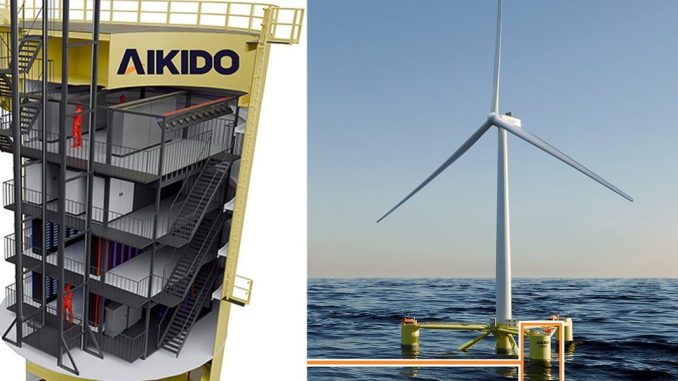
As data-center developers frantically seek to secure power for their operations, one startup is proposing a novel solution: Build them into floating offshore wind turbines.
San Francisco–based offshore wind-power developer Aikido Technologies today announced its plans to start housing data centers in the underwater tanks that keep its turbine platforms afloat. The turbines will supply the power for the servers, and onboard batteries and grid connection will provide backup.
The company’s first prototype, a 100-kilowatt unit, is scheduled to launch in the North Sea off the coast of Norway by the end of this year. A 15-to-18-megawatt project off the coast of the United Kingdom may follow in 2028.
Aikido is one of several companies planning data centers in unusual places—underwater, on floating buoys, in coal mines and now on offshore wind turbines. The creativity stems from the forces of several trends: rapidly rising energy demand from data centers, the need for domestic renewable power production, and limited real estate.
The North Sea serves as an ideal first spot for floating, wind-powered data centers because European policymakers and companies are looking to regain domestic control over energy production. They’re also looking to host an AI economy on servers within the continent’s boundaries. Floating wind platforms keep the compute out of sight while tapping the stronger, more consistent air streams that blow over deep waters, where traditional, seabed-mounted turbine monopiles can’t go.
“A lot of energy in the clean-energy space is focused on powering AI data centers quickly, reliably, and cleanly in a way that does not upset neighbors and remains safe, fast, and cheap,” says Ramez Naam, an independent clean-energy investor who does not have a stake in Aikido. “Aikido has that, and a smart team,” he says.
Floating Wind-Power Designs Evolve
Aikido’s design builds on many iterations tested by the growing floating wind industry. When Norwegian energy giant Equinor finished construction on the world’s first floating wind farm in 2017, it kept the turbines upright with ballasted steel columns extending 78 meters into the water—a design called a spar platform. This gave it a dense mass like the keel of a boat. Since then, the floating wind industry has largely coalesced around a semisubmersible design based on oil and gas platforms. Semisubmersibles don’t go as deep as spar platforms; instead, they extend buoyancy horizontally. Anchors, chains, and ropes keep the platform floating within a certain radius.
Aikido is taking the semisubmersible approach. Its football-field-size platform holds the turbine in the center, and three legs extend tripod-like outward, like a Christmas-tree stand. At the end of each leg is a ballast that reaches 20 meters deep. This holds tanks largely filled with fresh water to maintain the platform’s buoyancy in the salty ocean.
The data centers will go in the upper part of each ballast tank. There’s room for a 3- to 4-MW data hall in each tank, giving the platform a combined compute of 10 to 12 MW. Below the data halls is an open chamber used as a safety barrier, and below that sit the freshwater tanks. The water is piped up to the data center for liquid cooling of the servers. The warmed water is then funneled back down the ballast into the tank. There, proximity to the cold ocean water cools it again as the heat is conducted out through the tank’s steel walls.
“We have this power from the wind. We have free cooling. We think we can be quite cost competitive compared to conventional data-center solutions,” says Aikido CEO Sam Kanner. “This crunch in the next five years is an opportunity for us to prove this out and supply AI compute where it’s needed.”
One challenge, he says, is that liquid cooling can’t cover all the data center’s needs. For example, heat generated from Ethernet switches that connect the GPUs can’t be liquid-cooled with commercially available technology. So Aikido installed an air-conditioning method for that.
Another challenge is the marine environment, which is “pretty brutal to engineer around because there’s the increased salinity, there’s debris, and there’s various kinds of corrosion and fouling of metal piping that you wouldn’t have in a freshwater environment,” says Daniel King, a research fellow at the Foundation for American Innovation in Washington who focuses on AI infrastructure.
Offshore Data Centers Face Challenges
Aikido’s plan avoids the prickly not-in-my-backyard complaints that are dogging both onshore wind and data-center projects. It might also circumvent some inquiries into water usage and power demand too, or so Aikido’s thinking goes.
But it might not be that easy. “Instinctively many people reach for offshore or even orbital outer-space data centers as a way to circumvent the typical burdens of environmental reviews,” says King. “But there could be more or additional requirements around discharging heat and the effects that has on marine life that are different from the considerations of a terrestrial data center. It’s unclear to me whether this actually makes life easier or harder for a developer.”
Prefabricated data halls could be installed quayside, followed by final electrical and plumbing connections to commission the data center.Aikido
Aikido’s “design choice to use the fresh water in the ballast as a working fluid is a novel one” that, thanks to the closed-loop system, may “alleviate some of the engineering problems you see when a really high temperature fluid is pumping its heat directly into a marine environment,” King says.
Offshore sites are also vulnerable to sabotage, King notes. Since Russia’s invasion of Ukraine, fleets of vessels directed by the Kremlin have reportedly started messing with offshore wind and communications infrastructure in northern Europe. Russian and Chinese boats have allegedly cut subsea cables in recent years.
But vandalism is a risk anywhere, including at conventional data centers, Aikido CEO Kanner notes. Unlike those on land, where the local police have jurisdiction, Aikido’s data centers would enjoy protection from national coast guards, which he suggests gives an added degree of security.
North Sea Hosts Clean Energy
Kanner first began thinking about offshore wind turbines as a place to build data centers after a chance phone call with a cryptocurrency billionaire. The financier wanted to know whether turbines in international waters could power servers generating digital tokens at a moment when crypto-mining faced increased scrutiny from regulators. The talks fizzled. But that encounter sparked Kanner’s curiosity about how to use power generated onboard floating turbines.
When ChatGPT emerged in 2022 and sparked a heated debate over how to power and cool such technology, the idea to put the data center in the floating turbine clicked for Kanner. The idea really congealed after he met with the chief executive of Portland, Ore.–based Panthalassa. The wave-energy company was proposing to enclose small, remote data centers in buoys attached to equipment that generates power from the surf. Panthalassa just completed its full-scale prototype tests off the coast of Washington state last summer.
At that point, Aikido had already designed a modular platform for floating wind turbines. Each platform consists of 13 major steel components that are snapped together with pin joints—like IKEA furniture. The platforms fold up in a flat configuration that takes up roughly half the space of other designs, allowing it to be transported by a wider range of ships, according to Aikido. From there, it was a matter of figuring out how to accommodate a data center in the unused space.
Aikido’s prototype will use a refurbished Vesta V-17 turbine. It will need onboard batteries for backup power and will also be connected to the grid for additional power during seasons with less wind. Aikido envisions eventually sprinkling its data centers among large arrays of offshore turbines to tap into that larger power infrastructure.
Between Russia’s threat to expand its war in Ukraine to EU countries and the Trump administration’s bid to pressure Denmark into ceding sovereignty of Greenland to Washington, Europe is scrambling to build up its own energy production and AI capabilities. The North Sea, increasingly, looks like a primary theater of that effort. In January, nearly a dozen European nations banded together in a pact to transform the North Sea into a “reservoir” of clean power from offshore wind.
From Your Site Articles
Related Articles Around the Web



