
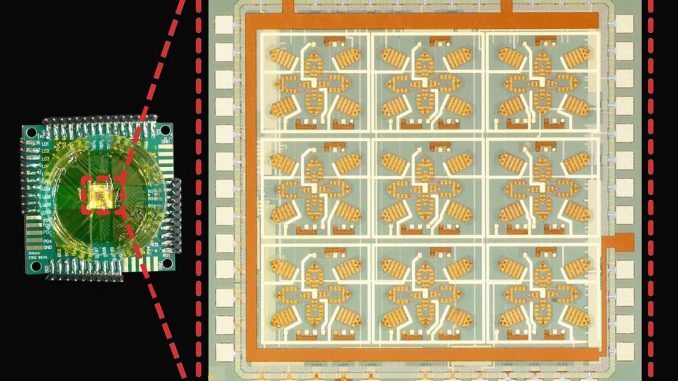
Living cells and tissues grown in the lab are vital tools for helping scientists learn about basic biology and test new drugs. Growing miniature organs on a chip from a person’s stem cells could even one day help doctors test personalized treatments.
Now, researchers have developed a lab-on-chip that adds a new feature to these systems: low-power grippers that can hold cells or tiny organ models called organoids in place. The CMOS-compatible lab-on-a-chip features shape-memory grippers and chemical sensors for detecting molecules such as neurotransmitters. The micro-cage array was presented in San Francisco on 18 February at the IEEE International Solid State Circuits Conference.
Researchers working on this multifunctional system hope it will be used to sense and manipulate biological samples of different sizes and potentially help direct the development of stem cells into organoids, which are used to study basic biology and drugs. Growing neural organoids in lab-on-a-chip systems, for instance, can help biologists study brain development and how it’s impacted by chemicals or drugs. Cage-like grippers could be used to hold samples in place, or to bring tissue samples next to each other to encourage their development.
Building bioelectronic systems directly on a chip is attractive because it makes it easy to integrate many different features, including chemical sensing, electrical sensing and stimulation, and physical manipulation. However, manipulating biological samples on CMOS chips can be tricky, says Adam Wang, an electrical engineer at ETH Zurich. Optical and acoustic tweezers, for example, can heat up, while the electrical fields used to generate motion in dieletrophoresis can be weakened by high concentrations of ions in the media used to support cells and tissues. These methods also require continuous power inputs. Wang presented the research on behalf of lead student Zhikai Huang, who was unable to attend.
How the Microcages
The ETH chip integrates tiny grippers to “cage” biological samples. These grippers are based on so-called shape-memory alloys, layered metal structures that change their shape in response to electrical signals, then hold that shape without the need for any additional power.
The ETH chip holds an array of nine sets of microcages, along with control electrodes and electrodes for chemical sensing. At each spot on the array, cages of three different sizes are nested together like rows of concentric flower petals. Their arms are 100, 150, and 280 micrometers long. The smallest might be used to grab single cells while the largest is designed to grapple with whole organoids.
The arms are made of layered platinum and titanium. Each of the three different sized sets has its own dedicated control electrode. In response to the polarity and magnitude of a signal, the cage arms will either bend and curl upward or flatten back down onto the surface. The electrical signal triggers the movement by changing the electrochemical state of the platinum. Once the cages change shape, they stay in place with no additional power, unless they receive an electrical order to open or close again. The array includes electrochemical sensors in the form of electrodes made of gold, platinum, and palladium. Using different electrode materials with different properties enhances the sensitivity of the system, says Wang. And all these materials can operate in electrolytes, including the cell culture media that help sustain biological cells and tissues in the lab.
At the conference, Wang presented the circuit design, and initial tests using the cages to grip onto glass beads and measure concentrations of ferrocyanide, a chemical commonly used to test lab-on-a-chip sensors. Next, they hope to demonstrate that the array can delicately handle biological cells and organoids, and measure biochemicals such as neurotransmitters. Wang says future versions of the CMOS platform could integrate more electrodes for electrical sensing and stimulation of nerve cells.
From Your Site Articles
Related Articles Around the Web



