
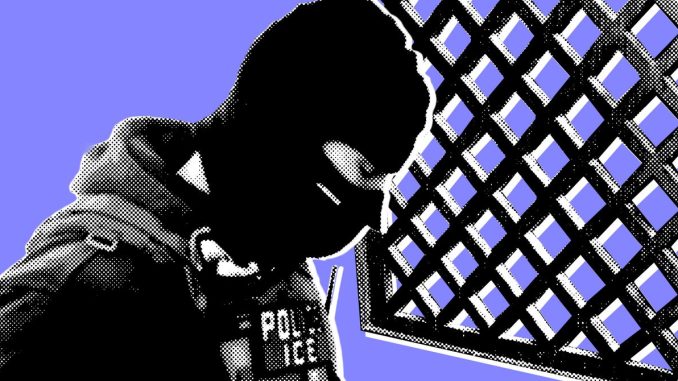
As immigration became one of the defining focuses of Donald Trump’s second administration, the Department of Homeland Security (DHS) has taken center stage. Under the 2025 One Big Beautiful Bill Act, DHS, which oversees Immigration and Customs Enforcement (ICE), Customs and Border Protection (CBP), US Citizenship and Immigration Services (USCIS), and several other agencies, received more than $80 billion in additional funding, and in January the agency announced that it had hired more than 12,000 new agents.
Even as cities like Los Angeles and Minneapolis have seen a surge of immigration officers descend upon them, DHS has maintained a high level of opacity around its operations. Officers carrying out raids and arrests are often masked and driving in unmarked cars. As enforcement has pulled in federal law enforcement personnel from across the government, it has become difficult to tell what agency a given officer works for, let alone who they actually are. Though DHS has been combative with the media, ICE agents themselves have been mostly quiet, even if some have mixed feelings about their work and where the agency is headed.
Karl Loftus, an independent journalist who runs the Instagram account @deadcrab_films, started a new project following the immigration surge in Minneapolis called Confessions of an ICE Agent. There, he publishes interviews with people who work in immigration enforcement across DHS. This includes agents and officers with the two main divisions of ICE—Homeland Security Investigations and Enforcement and Removal Operations—as well as CBP officers. He offers them anonymity and a place to speak their minds outside the structures of traditional media, and in return gets a glimpse of what the people inside the agency are experiencing, creating an archive of this moment in its history.
In one post, a biracial agent speaking shortly after Trump announced that he would be replacing DHS Secretary Kristi Noem told Loftus he believed Noem was a “DEI” hire. In another, an HSI agent called the people leading the US government “imbeciles,” saying they were “disgusted by nearly all of them.” Another HSI agent expressed concerns about DHS colleagues violating the law, and complained of having to pause investigation into child sexual abuse cases to focus on immigration work. “If they gave child exploitation cases a fraction of the attention, funding, resources, personnel, analytical support, etc. that they’re now giving immigration enforcement, we could do so much good,” they said.
WIRED spoke to Loftus about the public response to a polarizing topic, how he vets his sources, and the pressure to pick a side. A DHS spokesperson responded to WIRED’s request for comment saying that they cannot verify anonymous interviews but that DHS and its Homeland Security Investigations unit “is not slowing down and remains committed to all aspects of its mission, leveraging a whole-of-government approach to address threats to public safety and national security.”
This conversation has been edited for length and clarity.
WIRED: Before this project, your account mostly focused on things like disaster recovery after Hurricane Helene and similar topics. How did you start working on ICE?
Karl Loftus: In 2018 I was a volunteer in North Carolina during Hurricane Florence. I was there during the hurricane for four days doing search and rescue. That kind of started my passion for disaster response. I had been in Jamaica for seven weeks responding to Hurricane Melissa, working with a handful of different NGOs. I worked with Global Empowerment Mission repairing roofs of hospitals and medical centers to try to get the medical infrastructure back on track. I worked with World Central Kitchen. I was there documenting. I had planned to go to Wisconsin for the holidays, which is where I’m from, to visit some family, but I ended up staying in Jamaica. In early January, I finally made it up to the Midwest to see some family, and that’s when the Renee Good shooting happened. I was like, “Man, I know shit’s about to go insane the following day, and there’s going to be protests and riots and all this stuff.” So I decided to make the trip to Minneapolis.



Be the first to comment