
Unlike Superman, researchers at Adelaide University in Australia don’t claim to possess X-ray vision, but they have found a way to remotely observe the electrical activity of transistors inside a chip while they are working and without disturbing their operation. Rather than X-rays, the scientists use terahertz waves to detect tiny changes associated with the motion of electric charge inside packaged semiconductors.
Though still in the early stages of development, if refined and scaled up, this non-invasive probing system could change the way chips are tested, reducing reliance on techniques such as electronic probing and X-ray inspection, which can produce fine images of a chip’s structure, but cannot observe its electrical behavior.
“We built the system with off-the-shelf components,” says Withawat Withayachumnankul, professor of engineering at Adelaide’s University and group leader for the research that also involved colleagues at Virginia Diodes in the United States and at the Hasso Plattner Institute and the University of Potsdam in Germany. “It requires line-of-sight, but it can penetrate chip packaging materials that are non-metallic.”
The operation begins with a vector network analyzer (VNA)—a laboratory tool that can generate a microwave signal with a known frequency and phase. The signal is converted into a terahertz wave by a device called a VNA frequency extender (supplied by Virginia Diodes), which then radiates the wave towards the chip to be tested. Before reaching the target, the terahertz radiation passes through an objective serving as a focusing lens, which concentrates the beam onto an area as small as 1 square millimeter—big enough to contain 5 bipolar junction transistors in this experiment.
When transistors switch on and off, they slightly alter the signal’s properties, and the reflected wave is returned along the same path to a receiver in the VNA extender. There, it is down-converted back to the microwave frequency and compared with the original signal.
By measuring the tiny differences in amplitude and phase, the system can infer changes in the movement of charge inside the chip. In particular, the researchers found that as the PN junctions in monitored transistors became more conductive—with more charge carriers present—the reflected terahertz signal became stronger.
“I’m not aware of any inspection technology that can do this. That’s exciting”—Daniel Mittleman, Brown University
A device called a homodyne quadrature receiver plays a central role in the process. It compares a signal with a matched-frequency reference to detect changes. Normally employed at lower frequencies, it is used here to detect extremely small, fast changes in the terahertz signal that would otherwise be invisible.
“We had to hack it to work in the terahertz domain, given the complexity of measuring both the strength and timing of a wave at such high frequencies,” says Withayachumnankul.
Because the terahertz wavelength is much larger than the feature being probed, the interaction produces only a very small change in the reflected signal. Noise from the oscillator in the VNA that produces the original microwave signal can easily obscure that change. “That’s why we opted to use a homodyne quadrature receiver to compare the probe signal with the original,” says Withayachunankul. “Noise that is shared by both signals is largely cancelled in the comparison, leaving only the changes induced by the chip’s electrical activity to stand out.”
“Homodyne detection is critical here,” says Daniel Mittleman, professor of engineering at Brown University, in Rhode Island. “It is what allows one to detect the changes in the terahertz signal imposed by the much lower-frequency megahertz electrical modulation of the [transistors being monitored]. Typical terahertz detection schemes would not be able to see that.”
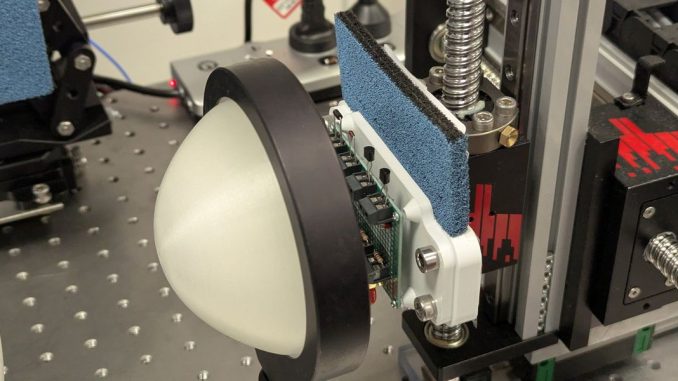
Terahertz radiation from a horn antenna [center] reflects off of a diode [right].Bryce Chung, Harrison Lees, et al.
Reflected terahertz radiation
Besides being able to penetrate non-metallic semiconductor packaging, terahertz waves are a harmless and non-ionizing form of electromagnetic radiation, and so have the potential to provide a safer alternative to inspection methods that rely on X-ray or invasive probing, according to the researchers.
“The plastic and ceramic used in most semiconductor packaging are thin enough that they do not excessively absorb terahertz waves,” says Withayachumnankul. “So there is no need to remove it. This means we can measure semiconductor activity in situ.”
While packaging may not be a problem for terahertz inspection, other aspects of modern chips might be. “In general, modern chips consist of many layers, sometimes just interconnects, and sometimes also active circuity,” says Mittleman. “It’s not clear that these layers are all transparent to terahertz radiation.” Consequently, he points out that this detection technique may have a problem if the target device is buried under a dozen other layers. “If those over-layers are opaque, then this technique cannot be used to diagnose that deeply buried device. That’s the limitation of the idea.”
Given the relatively low sensitivity of the system at this stage of development, the researchers have mostly confined their testing to discrete devices, monitoring in real time the changes in switching and states of devices such as rectifier diodes, bipolar junction transistors, and field-effect transistors (FETs). More recently, they have moved on to test integrated circuits containing up to half a dozen FETs.
The next major challenge is to improve the technique’s sensitivity in order to examine more densely-integrated chips. “We have several ideas how to do this, but I’m not ready to talk about them yet,” says Withayachumnankul.
Eventually, after the technology is refined and perfected, he says this approach would be particularly attractive for safety-critical applications such as high-power electronics, where devices cannot easily be taken offline without causing operational disruption. Additionally, with the help of his collaborators in Germany, Withayachumnankul is aiming to use the technique to read encrypted data in chips, which could have implications for security.
“The idea of using terahertz imaging for studying semiconductor devices has been around for quite a while,” says Mittleman. But this work opens the possibility of “diagnosis of a device under operation within a package. I’m not aware of any inspection technology that can do this. That’s exciting.”
The research was published in IEEE Journal of Microwaves on 17 March 2026.
From Your Site Articles
Related Articles Around the Web



Be the first to comment