
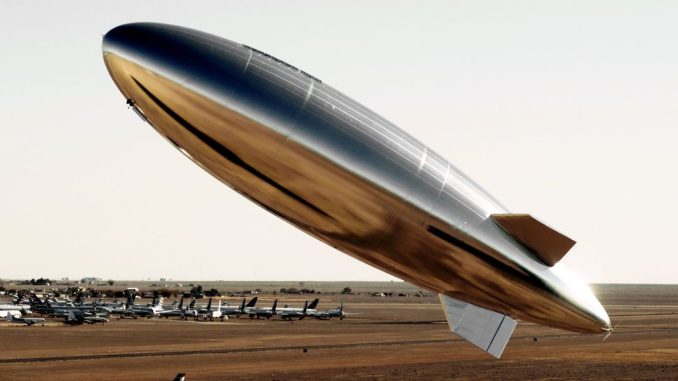
Later this year, a certain airship will lift off from New Mexico to embark on a Pacific crossing for its longest flight yet. But the real test won’t begin until it arrives in Japan. There, the airship’s builder, New Mexico-based Sceye, and its funder and partner, the Japanese telecom giant SoftBank Corp., plan to test the craft’s mettle as a floating cell tower 20 kilometers in the sky.
They are not alone in planning base stations in the stratosphere. In theory, floating platforms can provide better line-of-sight coverage than ground towers, with less latency and more capacity than satellites in low Earth orbit. So, some engineers think the stratosphere will be a crucial piece of future mobile networks—if they can get the craft working.
“There is still, in my view, some work to be done on the aerospace part to perfect the aircraft, but this technology is coming,” says Halim Yanikomeroglu of Carleton University in Ottawa, who is unaffiliated with Sceye.
How to build a base station in the sky
Sceye’s craft is an example of a high-altitude platform station (HAPS), delivering Internet access from Earth’s stratosphere. HAPS come in many different designs. Sceye’s choice is a autonomously piloted, helium-filled airship that is solar-powered during the day and battery-powered at night.
In past tests, Sceye showed that its airship can ascend into the stratosphere, then keep position through day and night with electric fans. Although a 20-km altitude is above most ground weather, staying in place is still an engineering feat due to the stratosphere’s fierce winds. Now, the company is testing longer-duration flights, ramping up to multi-month-long runs like its planned Pacific crossing.
A HAPS base station may need to stay in one place for months, if not even longer to be useful for networking. The record belongs to a fixed-wing aircraft from Airbus-owned Zephyr, which last year reportedly stayed aloft for 67 days.
Sceye can’t match that mark yet, but Sceye’s CEO Mikkel Frandsen believes his company’s lighter-than-air design has a different advantage: payload capacity. Where craft like Zephyr’s can carry just a few kilograms, Frandsen says, Sceye is testing payloads as heavy as 250 kg.
The extra capacity translates to more capable networking equipment. In Japan, Sceye will test an antenna the company calls SceyeCELL, a module of MIMO panels designed for use in the stratosphere.
Why telecom companies want HAPS
In total, Frandsen says Sceye is planning “two, likely three” commercial tests with multinational telecom companies this year.
One reason for this interest may be that, unlike the satellites of Starlink, SceyeCELL transmits data at frequencies that mobile phones already use. Sceye’s antenna also operates with the same 3GPP standards as terrestrial base stations, called eNodeB for 4G and gNodeB for 5G. This means a smartphone on the ground shouldn’t tell the difference between a terrestrial base station and Sceye’s floating one. HAPS researchers say this sort of seamless connectivity is crucial.
What else, according to researchers, must a HAPS network demonstrate to show it’s ready for the real world? The HAPS itself must stay in position; then, its antenna must show its quality.
Devices on the ground must maintain a reliable link with low latency and stable throughput. HAPS promises to float above the weather with better line-of-sight coverage, but those promises are no good if its coverage falters in storms below, or among the high densities of urban high-rises. If multiple HAPS are to serve the same city, they need to communicate with each other. And an aerial network must not interfere with traditional cell signals.
“’For HAPS to work…in areas where terrestrial base stations do exist, it is really essential to have proper interference management,” Yanikomeroglu says.
Sceye isn’t testing inter-HAPS communication yet, but Frandsen says they are working on other requirements: “We intend to show that we can backhaul into the customer’s core network. We intend to show that we can beam on the front end, direct-to-device, with expected speeds, with minimum levels of interference.”
A bridge through the stratosphere?
Past HAPS concepts, like the balloons of Google’s now-shuttered Loon, largely aimed to bring Internet connectivity to remote areas. “These projects have proven not to be very sustainable from an economic perspective, especially in comparison with satellite systems,” says Marco Giordani of the University of Padova in Italy, who is unaffiliated with Sceye.
Because of those headwinds, HAPS proponents are now thinking about using HAPS for permanent use in more populated areas. “HAPS has a wide coverage,” says Animesh Yadav of Ohio University in Athens, Ohio, also unaffiliated with Sceye. “If you are just using it for rural areas, you are just underusing it.”
For example, according to Frandsen, SoftBank is interested in using HAPS to densify satellite coverage. Most phones today lack the required antenna for a good connection to low Earth orbit. SoftBank is not alone in trusting HAPS to bridge this gap.
“In this case, the HAPS can act as a relay station, to receive the traffic from ground users and then relay and forward the traffic up to the satellites and back,” says Giordani. “This, I think, it’s very promising.”
HAPS proponents envision a network of the future—if not 6G, then 7G or beyond—that meshes Earth, sky, and space, with HAPS as a floating middle layer. Some researchers have proposed more ambitious ideas, like mounting HAPS with the equipment for tasks like edge computing and federated learning.
Of course, engineers must first prove that HAPS are capable of the basics.
From Your Site Articles
Related Articles Around the Web



Be the first to comment