
A quantum computer can be an ungainly thing, because even the most elegant qubit-housing cryostat usually sprouts a thicket of control cables.
Most qubits don’t work above a fraction of a degree above absolute zero, but the conventional electronics that control the qubits don’t work in the cryogenic cold. Hence connecting cables need to route information out of the cryostat. The more qubits a computer has, the more cables it needs. More than an eyesore, this overgrowth is a problem for scaling quantum computers. The wires are a pathway for heat that can destabilize the sensitive qubits.
Engineers can clear some of the cable weeds if they get control electronics that work in the cold, next to the chilly qubits. A month-old startup named S-Transistors has a plan: make the needed circuits out of superconducting transistors that can operate in the qubit’s ultracold environment.
Spun off from Finland’s VTT Technical Research Centre, the Espoo-based firm did not invent the superconducting transistor. Instead, S-Transistors thinks they have made a breakthrough in making superconducting transistors in the fab. They plan to put their first circuits on the market in 2027.
“We don’t claim to make the best superconducting transistors, but we can make a lot of them on wafer-scale, and we can actually be the first to start combining them into new kinds of superconducting integrated circuits that didn’t exist before,” says Heorhii Bohuslavskyi, CEO and co-founder of S-Transistors, and formerly a researcher at VTT.
Making a graphene sandwich
The heart of S-Transistors’ technology is the Josephson junction. A Josephson junction consists of two superconductors sandwiching a nanoscale layer of another material. A key feature of a superconductor is that, at a cold enough temperature, electric current will flow through the superconductor with no resistance and no loss. Ordinarily, the Josephson filling does absolutely nothing to stop this. But increase the current past a certain limit—the so-called critical current—and the Josephson junction will snap out of superconductivity for a tiny fraction of a second at a time. This flicker creates a tiny voltage pulse that can be controlled.
Many quantum computers themselves use Josephson junctions as the building block for superconducting qubits.
S-Transistors augments their Josephson junction with a third terminal, which acts like the gate in a typical field-effect transistor. Applying an electric field across this third terminal can control the junction’s critical current. This is called a Josephson field-effect transistor (JoFET). Engineers can combine multiple JoFETs to create superconducting circuits and more.
The JoFET is not new—engineers have tried making them since at least the 1980s—but the researchers behind S-Transistors say they’ve now made a breakthrough at making them at scale in the fab.
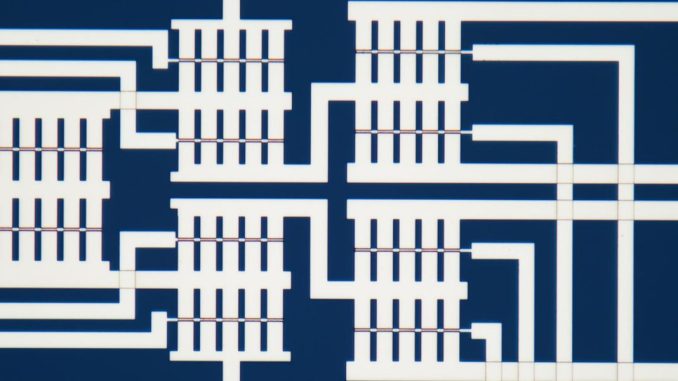
Superconducting transistors are not new, but S-Transistors is now manufacturing them at wafer-scale in CMOS foundries. S-Transistors
They fabricate their superconducting transistors on a 6-inch (150-mm) silicon wafer. Their CMOS-compatible process involves laying a graphene channel upon the wafer and shaping three electrodes from an aluminum-based superconductor.
Two of these electrodes touch the graphene channel to create an aluminum-and-graphene Josephson junction. Then, controlling the voltage through the third electrode—the gate—can change the critical current, or switch the superconductivity on or off.
Graphene isn’t normally a superconductor, but with the right conditions, the electrodes can “leak” their superconductivity into the graphene. The researchers spent years fine-tuning their process to achieve those conditions. Their device’s geometry, materials, and engineering had to be just right.
Generalov and colleagues think they have accomplished this. Now, they are looking to assemble them into more complex integrated circuits. “The very next step in the near future is to demonstrate circuits consisting of hundreds of superconducting transistors,” Generalov says.
A cable-pruning plan
Superconductors operate at very cold temperatures, so they can bring room-temperature tasks closer to the qubits. Starting in 2027, S-Transistors will make and sell superconducting multiplexers and demultiplexers designed to route the signals into the qubits, cutting some of the cumbersome cables that do this today.
Beyond that, S-Transistors wants to trim a great deal more cables with a superconducting “motherboard” that handles multiple control functions. Bohuslavskyi thinks their superconducting transistors could be used to make amplifiers, memory, and other circuits, both analog and digital.
There are other ways to bring a quantum computer’s control systems closer to its qubits, such as cryo-CMOS: more traditional electronics that are nevertheless engineered to operate in a quantum computer’s conditions.
Cryo-CMOS may best serve some electronics, but for parts nearest the qubits, S-Transistors believes that the superconducting transistor has some advantages. Superconducting transistors are more directly compatible with qubits, and they leak less qubit-destabilizing power than cryo-CMOS.
“There’s potential for a new kind of cryogenic electronics platform to operate at much faster speed while dissipating much less power than the current cryo-CMOS technologies,” Bohuslavskyi says.
From Your Site Articles
Related Articles Around the Web



Be the first to comment