
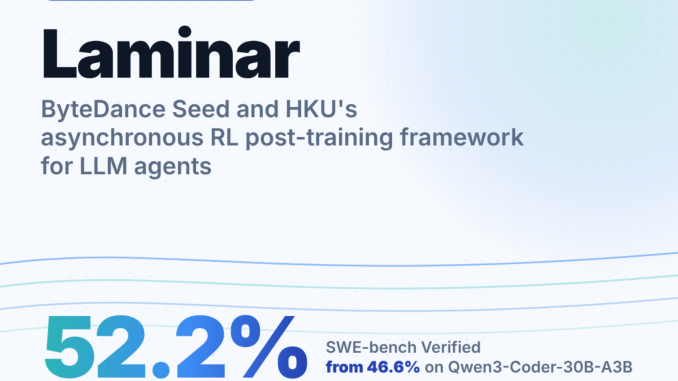
Researchers from The University of Hong Kong and ByteDance Seed have open-sourced Laminar. Laminar is an reinforcement learning RL post-training framework for LLMs and long-horizon agents. The core idea is simple: stop forcing every trajectory and every GPU to wait for the slowest one. For teams training coding agents with long, skewed rollouts, that is where most GPU time goes.
TL;DR
What: A framework. Tested on Qwen3-Coder-30B-A3B-Instruct (30.5B total, 3.3B active) and Qwen2.5 at 7B, 32B and 72B.
Runs on: Multi-node NVIDIA GPU clusters with Ray and CUDA. Tested on 64x H800 and up to 1024 H800 GPUs. vLLM for inference, Megatron-LM or FSDP2 for training.
Performance: Strong end-to-end gains on SWE agent RL and up to 5.48x throughput in the paper.
Best: 52.2% on SWE-bench Verified, up from 46.6% for the base model.
Worst: Early repo (1 commit at launch), vLLM is the only listed inference backend, and per-step async checkpointing is still in progress.
Bottom line: Best: fewer samples and GPU-hours to a higher SWE-bench score. Worst: the headline comparison mixes H800 and H100 hardware.
What is Laminar?
Laminar is an asynchronous RL post-training framework that decouples rollout, buffering, training and weight transfer into independent loops. It is built on verl and Uni-Agent and released under Apache-2.0.
The launch blog splits the stack into 3 layers. verl provides training and inference compute backends. Uni-Agent handles agent execution, tool calls and sandboxes. Laminar handles cluster-scale orchestration.
How does Laminar’s architecture work?
The design rests on 3 principles: full decoupling, fine-grained asynchrony and fault tolerance.
Rollout loop: Drives agent interactions and serves generation across inference replicas.
Experience buffer (data plane): Separates trajectory production from training and serves ready batches on demand.
Training loop: Samples batches, computes advantages and off-policy corrections, and publishes weights.
Weight Relay (weight plane): The trainer stages weights into per-node shared CPU memory and keeps going. Replicas pull updates on their own schedule.
In the research paper, relays are CPU processes, 1 per rollout machine. They broadcast weights along a pipelined RDMA chain. A 72B model reaches 127 other relays in under 1.6 seconds.
What is version-consistent rollout?
Most async systems use version-mixed partial rollout. They interrupt in-flight trajectories at each weight update and resume under the new policy. That forces repeated re-prefill.
Laminar also supports a version-consistent mode. Each trajectory finishes under 1 policy version. Replicas update independently, without a global weight-switch barrier. The blog states that this keeps the prefix KV cache intact. It argues re-prefill cost scales cubically with sequence length under frequent updates.
Repack handles the tail. Once new weights exist, leftover old-version trajectories are consolidated onto fewer replicas. Drained replicas then load the new version immediately.



Be the first to comment