
The U.S. semiconductor industry is booming but industry watchers fear the country’s workforce is unprepared.
By 2030, investments in manufacturing, design, materials, and packaging facilities in the United States will create demand for 189,000 new full-time semiconductor jobs. But the supply of such workers will only reach about 62,000 people, the National Network for Microelectronics Education (NNME) estimated in July. “The US is facing a critical shortage of workers for the semiconductor industry,” says Jennifer Taylor-Mendoza, president of West Valley College in Saratoga, California. “Rebuilding this workforce is not optional.”
“Community colleges are the gateway,” says Leah Palmer, Executive Director of the Arizona Advanced Manufacturing Institute at Maricopa Community Colleges (MCC), a network of 10 colleges. “Not everyone can afford university. Not everyone is prepared for university.” But community colleges are well placed to meet those potential workers where they are and help them fill the need of the semiconductor industry.
The biggest shortage is of engineers, who make up about 60 percent of the total unmet demand, the NNME reports. But technicians to maintain machines, run quality control, and manage facilities are also in demand, to the tune of potentially tens of thousands of unfilled jobs by 2030. These jobs require only an associate’s degree or a high school diploma and some additional training. People with those qualifications now in the service industry might improve their lives by taking technical jobs, but only if they know these jobs exist.
The semiconductor worker shortfall is the kind of challenge that community colleges were built for, Taylor-Mendoza says. Community colleges have a long history of helping train people quickly and affordably for critical jobs such as nursing, court reporting, or making computer chips. Community colleges in regional semiconductor hubs are now offering apprenticeships, certificates, and other training to enable people to update their skills or pivot to new career paths in the industry. They funnel some graduates into engineering programs at nearby universities to get 4-year degrees, and recruit and train high school students.
If you build it, will they come?
In response to the 2022 US CHIPS and Science Act, companies have announced 140 new projects and investments of more than US $640 billion in the country, according to a September report by the Center for Security and Emerging Technology (CSET). TSMC, for instance, plans to invest $165 billion in the US. Its chip fab in Arizona began production in 2024, and the company plans to open 3 more fabs and two packaging facilities. The Arizona fab employs about 3000 people, and when another two open, the company will need about 6000 employees in the region, including thousands of technicians.
“‘Build it and they will come’ doesn’t work” with semiconductor fabs, says Palmer of Maricopa Community Colleges (MCC), which collaborates with TSMC, Intel, and other companies on its semiconductor curricula. MCC recruits high school students and performs marketing in the region, educating people about jobs in the semiconductor industry and the training they need to get a foot in the door. Then they provide that training, often at no cost to students.
In 2023, MCC began offering a 10-day training program for the semiconductor industry called Quick Start. Palmer says 1500 people have completed the program, which has a waiting list of thousands. At MCC and other community colleges, industry representatives review curricula to make sure they are tailored to the real needs of employers and are often a source of instructors, too.
For $306 Quick Start students learn how to read schematics, use hand tools, and the basics of vacuum technology. But students only pay if they do not complete the program. Those who do finish get an invitation to an industry job fair.
Like many such community college programs, Quick Start is “stackable,” meaning students can convert their participation into credits toward more advanced certificates or degrees. Community colleges also offer training for existing semiconductor employees to improve their skills, apprenticeships, and training for high school students.
“Having a variety of programs is important,” says Pearl Chang Esau, CEO of Shàn Strategies, a consulting firm that works with TSMC to develop training for community colleges. Some students must work full time. Others have families to take care of and long commutes to campus. “We have to increase access for learners, or we’re going to have a workforce gap,” she says.
Get in the pool
Laura Marmolejo, dean of advanced manufacturing at Austin Community Colleges (ACC), says representatives of the more than 200 Texas semiconductor plants have told her they need new workers. The industry’s message, she says, is, “We need more people in the pool, otherwise we’re just stealing each other’s employees.”
Part of the problem is visibility. “No one knows what semiconductors are,” Marmolejo says. ACC invites high school students to tour their facilities.
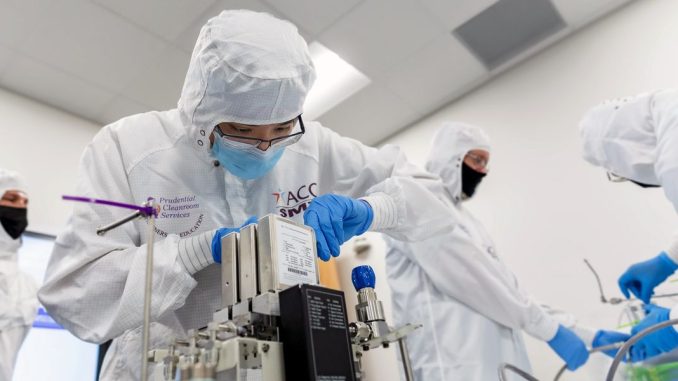
A clean room is hard to imagine if you’ve never been in one, and 12-hour shifts in a full “bunny suit,” with goggles and gloves might not be for everyone. So, at ACC, students go down the rabbit hole, wearing clean-room suits for some practical classes. The school also uses virtual reality to simulate some environments students might encounter and to teach tasks like checking for a vacuum leak. “You have to have that experience to make a decision about whether this is right for you,” Palmer says.
At West Valley College, students in a 15-week program learn about the semiconductor industry, then learn about key equipment and how to troubleshoot it. Part of it takes place at the nearby Stanford Nanofabrication Facility, where students build a transistor over a semester. Next year, West Valley College will open a fab on campus.
Students at West Valley College perform laboratory work.West Valley College
Can they close the gap?
Tracking semiconductor program graduates’ subsequent careers is challenging, says Palmer. “When the student leaves the college, we have a hard time getting hiring data back.” MCC sends graduates surveys to ask them to self-report their employment status at 30, 60, and 90 days.
While the community college population skews young, 40 percent of Quick Start participants are aged 30 to 49, suggesting that the program is attracting people who want to switch careers, says Palmer. The program has reached 35 percent women, which is relatively high for advanced manufacturing, says Palmer, while 36 percent of participants were Latino or Hispanic, and 13 percent were Black.
The CSET report concludes that developing a healthy U.S. semiconductor ecosystem will require reaching potential employees from underrepresented demographics, particularly women and Black and Hispanic people. Palmer is excited about the demographics of Arizona’s 10-day training program, which show that they are reaching a relatively diverse population.
Even with these efforts by community colleges, the NNME predicts there will be a shortfall in the US semiconductor workforce. Without more efforts to fill that gap, they warn, workforce shortages will hold back expansion of the industry in the US.
“It’s an all-hands-on-deck moment,” says Chang Esau.
From Your Site Articles
Related Articles Around the Web



Be the first to comment