
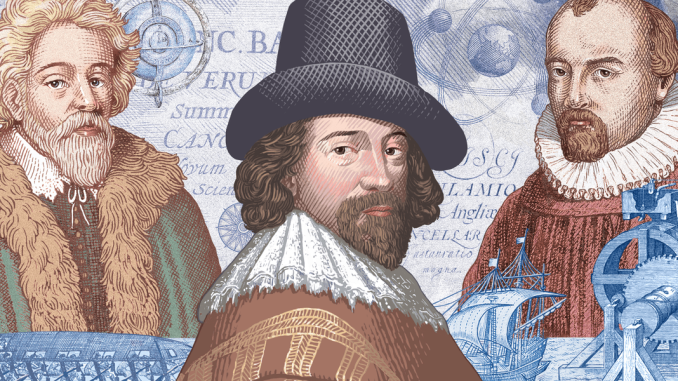
In 1627, a year after the death of the philosopher and statesman Francis Bacon, a short, evocative tale of his was published. The New Atlantis describes how a ship blown off course arrives at an unknown island called Bensalem. At its heart stands Salomon’s House, an institution devoted to “the knowledge of causes, and secret motions of things” and to “the effecting of all things possible.” The novel captured Bacon’s vision of a science built on skepticism and empiricism and his belief that understanding and creating were one and the same pursuit.
No mere scholar’s study filled with curiosities, Salomon’s House had deep-sunk caves for refrigeration, towering structures for astronomy, sound-houses for acoustics, engine-houses, and optical perspective-houses. Its inhabitants bore titles that still sound futuristic: Merchants of Light, Pioneers, Compilers, and Interpreters of Nature.
Engraved title page of The Advancement and Proficience of LearningPublic Domain
Bacon didn’t conjure his story from nothing. Engineers he likely had met or observed firsthand gave him reason to believe such an institution could actually exist. Two in particular stand out: the Dutch engineer Cornelis Drebbel and the French engineer Salomon de Caus. Their bold creations suggested that disciplined making and testing could transform what we know.
Engineers show the way
Drebbel came to England around 1604 at the invitation of King James I. His audacious inventions quickly drew notice. By the early 1620s, he unveiled a contraption that bordered on fantasy: a boat that could dive beneath the Thames and resurface hours later, ferrying passengers from Westminster to Greenwich. Contemporary descriptions mention tubes reaching the surface to supply air, while later accounts claim Drebbel had found chemical means to replenish it. He refined the underwater craft through iterative builds, each informed by test dives and adjustments. His other creations included a perpetual-motion device driven by heat and air-pressure changes, a mercury regulator for egg incubation, and advanced microscopes.
De Caus, who arrived in England around 1611, created ingenious fountains that transformed royal gardens into animated spectacles. Visitors marveled as statues moved and birds sang in water-driven automatons, while hidden pipes and pumps powered elaborate fountains and mythic scenes. In 1615, de Caus published The Reasons for Moving Forces, an illustrated manual on water- and air-driven devices like spouts, hydraulic organs, and mechanical figures. What set him apart was scale and spectacle: He pressed ancient physical principles into the service of courtly theater.
Drebbel’s airtight submersibles and methodical trials echo in the motion studies and environmental chambers of Salomon’s House. De Caus’s melodic fountains and hidden mechanisms parallel its acoustic trials and optical illusions. From such hands-on workshops, Bacon drew the lesson that trustworthy knowledge comes from working within material constraints, through gritty making and testing. On the island of Bensalem, he imagines an entire society organized around it.
Beyond inspiring Bacon’s fiction, figures like Drebbel and de Caus honed his emerging philosophy. In 1620, Bacon published Novum Organum, which critiqued traditional philosophical methods and advocated a fresh way to investigate nature. He pointed to printing, gunpowder, and the compass as practical inventions that had transformed the world far more than abstract debates ever could. Nature reveals its secrets, Bacon argued, when probed through ingenious tools and stringent tests. Novum Organum laid out the rationale, while New Atlantis gave it a vivid setting.
A final legacy to science
 Engraved title page of Bacon’s Novum OrganumPublic Domain
That devotion to inquiry followed Bacon to the roadside one day in March 1626. In a biting late-winter chill, he halted his carriage for an impromptu trial. He bought a hen and helped pack its gutted body with fresh snow to test whether freezing alone could prevent decay. Unfortunately, the cold seeped through Bacon’s own body, and within weeks pneumonia claimed him. Bacon’s life ended with an experiment—and set in motion a larger one. In 1660, a group of London thinkers hailed Bacon as their inspiration in founding the Royal Society. Their motto, Nullius in verba (“take no one’s word for it”), committed them to evidence over authority, and their ambition was nothing less than to create a Salomon’s House for England.
The Royal Society and its successors realized fragments of Bacon’s dream, institutionalizing experimental inquiry. Over the following centuries, though, a distorting story took root: Scientists discover nature’s truths, and the rest is just engineering. Nineteenth-century “men of science” pressed for greater recognition and invented the title of “scientist,” creating a new professional hierarchy. Across the Atlantic, U.S. engineers adopted the rigorous science-based curricula of French and German technical schools and recast engineering as “applied science” to gain institutional legitimacy.
We still call engineering “applied science,” a label that retrofits and reverses history. Alongside it stands “technology,” a catchall word that obscures as much as it describes. And we speak of “development” as if ideas cascade neatly from theory to practice. But creation and comprehension have been partners from the start. Yes, theory does equip engineers with tools to push for further insights. But knowing often follows making, arising from things that someone made work.
Bacon’s imaginary academy offered only fleeting glimpses of its inventions and methods. Yet he had seen the real thing: engineers like Drebbel and de Caus who tested, erred, iterated, and pushed their contraptions past the edge of known theory. From his observations of those muddy, noisy endeavors, Bacon forged his blueprint for organized inquiry. Later generations of scientists would reduce Bacon’s ideas to the clean, orderly “scientific method.” But in the process, they lost sight of its inventive roots.
From Your Site Articles
Related Articles Around the Web



