
For all the technological advances in diabetes care, the basic approach to treatment remains much the same: use drugs (such as GLP-1 therapies) or hormones (such as insulin) to change how the body handles sugar. But what if, instead of altering the body’s metabolism, doctors could remove excess sugar directly?
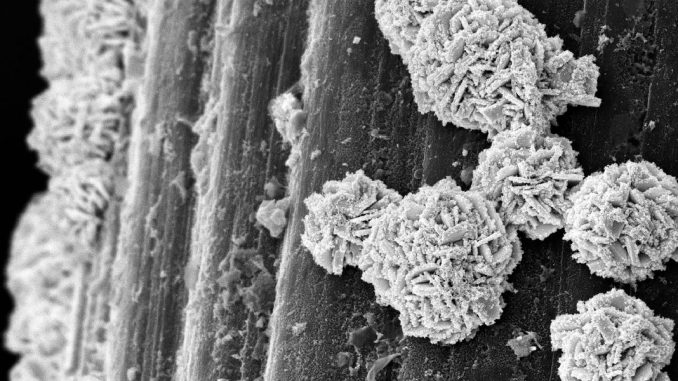
That’s the idea behind a wirelessly powered implant that harnesses electricity to drive a chemical reaction that converts glucose into a more easily excreted byproduct, which the kidneys can flush out in urine. The implant is built around gold flakes dotted with platinum particles—the electrodes that drive the reaction—and packed into a porous graphite matrix.
It’s “a paradigm shift in the biomedical use of electrocatalysis—from sensing glucose to actively regulating it,” says Salvatore Pullano, an electronics engineer at the Magna Græcia University of Catanzaro in Italy who was not involved in the study.
The technology builds on a growing class of diabetes devices known as closed-loop systems or bionic pancreases. These typically pair a continuous glucose monitor (CGM) with an insulin pump and software that adjusts insulin delivery in response to changing blood sugar levels, helping people stay within a healthy range with less manual intervention.
Such systems are now an established option for managing type 1 diabetes, the form of the disease that often strikes in childhood, when the immune system mistakenly attacks the pancreas’s insulin-producing cells. Closed-loop systems are sometimes used by people with insulin-requiring type 2 diabetes (T2D) as well.
The new technology, termed ECHO (electrocatalytic closed-loop health optimization) and described last month in Science, takes the same feedback-control principle but, instead of adjusting the supply of insulin, aims to eliminate excess glucose itself—an approach geared toward T2D, in which the body often still produces insulin but becomes resistant to its effects.
In mouse models of obesity-linked T2D, the device, when paired with a CGM, switched itself on whenever sugar levels crossed an upper threshold, holding the animals in the normal range for days at a time without a single dose of medication. If the system can be scaled to human blood volumes and proven safe long-term, it could offer an alternative to the injections and pills that dominate care today.
“It’s very creative and clever,” says Omid Veiseh, a bioengineer at Rice University who was not involved in the research. Plenty of practical obstacles stand between a mouse experiment and a device that works in people. “But it’s a stepping stone,” he says, “and I think there are definitely opportunities for more engineering to create an actual product.”
The implant comes together in three steps: bare board, wired board, and the finished module in its 3D-printed casing.Source images: Debasis Maity/ETH Zurich
How ECHO clears glucose
Developed by bioengineer Martin Fussenegger and his colleagues at the Swiss Federal Institute of Technology in Zurich, the implant is housed in a 3D-printed box, roughly the size of a small USB thumb drive, placed under the skin. That box is then wrapped in a cellulose bag and a plant-based coating for biocompatibility.
Inside the enclosure sits a scrap of graphite felt studded with platinum-coated gold nanoclusters, which serves as the glucose-clearing electrode, and a circuit board that draws its power from an external radio-frequency transmitter.
Cued from a nearby microcontroller, the transmitter gets switched on whenever an alarm from a CGM indicates that blood sugar levels have climbed too high. And crucially for the safety of a device that runs electric current through the body, the whole thing operates at half the voltage of a AAA battery—0.75 volts—which is well below the threshold at which water and chloride in blood would split into oxygen and chlorine, forming dangerous gas bubbles that could corrode nearby tissue.
The implant successfully converted excess glucose in mice to a metabolite called gluconate, which the animals largely peed out, with no ill effects in studies lasting up to 6 weeks. Separate experiments showed that the device remains functional for at least 3 months.
In the mice, the reduced blood sugar levels then set off a broader metabolic shift: away from burning sugar and toward burning fat, leading to slimmer critters with better blood chemistry profiles.
By draining sugar chemically rather than biologically, the implant could “provide for an extra assist” to a body that struggles to regulate itself, notes William Bentley, a bioengineer at the University of Maryland, College Park, who co-authored an accompanying commentary in Science on the research. “This is a way of checking your metabolism using an independent reaction network,” he says.
The path to human trials
With an eye to human-scale application, Fussenegger and his team also performed a benchtop experiment in which they pumped glucose-rich fluid through a laboratory version of the device at volumes of up to 5 liters—about the blood volume of an average adult man. Glucose clearance slowed as the volume grew, but bigger electrodes sped things up. Using an electrode approximately 50 times the size of one included in the mouse implant, the system could bring glucose levels down to near-normal in about three hours.
But a laboratory reservoir is a far cry from a living body, where blood flow, tissue responses, and other physiological factors could complicate glucose clearance or foul catalytic activity. An electrode large enough to clear glucose from several liters of fluid might also be impractical to fit inside an implant small enough for patients to tolerate. And it remains to be seen whether the device prompts biological substances other than glucose to undergo unwanted reactions.
The technology therefore is a long way from clinical reality, cautions Adam Heller, a retired chemical engineer from the University of Texas at Austin who pioneered the enzyme-electrode technology that underpins modern CGM devices. “You have to be terribly careful in extrapolating from the mouse to the human body,” Heller says.
Debasis Maity, a materials scientist in Fussenegger’s lab and the study’s first author, acknowledges that translating the technology to humans will require substantial redesign. “We need to adjust everything,” he says. Still, he believes the engineering hurdles are surmountable and hopes to test the device in larger animals, including rabbits and pigs, to gauge its safety, durability, and glucose-clearing capacity before moving toward human trials.
Opportunities beyond type 2 diabetes
The platform is not limited to glucose management either. In principle, Maity says, future implants could use different catalysts and electrodes to target different molecules in the bloodstream, with sensors triggering their activity as needed.
Potential targets include uric acid, which can contribute to gout and kidney problems when levels are elevated; bilirubin, which can build up in liver disease and cause jaundice; and ammonia, which climbs when the liver falters and can poison the brain.
Veiseh, for one, is more excited by those possibilities than by diabetes.
Glucose clearance is already a crowded field. Beyond insulin, people with T2D have the option of pills known as SGLT2 inhibitors that lower blood sugar by dumping it into urine—the same basic logic as the implant, minus the surgery—as well as newer GLP-1 drugs that lower both blood sugar and body weight, he says, well enough that an implant would struggle to compete.
The other potential targets have no such rivals. There is no Ozempic for jaundice, no Mounjaro for liver failure.
“There are several indications like that where you just want to break down a molecule rapidly,” Veiseh says. “You could imagine different iterations of this technology where it becomes selective for other toxins that you want to reverse.”
One potential limitation looming over all these applications is that the implant doesn’t destroy its target so much as repackage it, relying mostly on the kidneys—an organ often damaged in the very patients who would need the device—to carry the byproduct away. That could be a problem for the roughly one in three adults with diabetes who have chronic kidney disease. The same goes for those with gout, many of whom contend with impaired kidney function as well.
But as Maity points out, the kidneys are not the only route through which the body deals with gluconate. It may be the fastest way out, but there are slower, enzymatic pathways as well. As such, he neither dismisses the concern nor dwells on it. “Assessing the long-term effects in individuals with impaired renal function would require dedicated studies,” he says.
From Your Site Articles
Related Articles Around the Web



Be the first to comment