
Chinese public statements do not spell out military goals in the domain as bluntly as the US’s — Beijing’s 2022 white paper on its space programme emphasises the country’s peaceful approach. But the papers by PLA-affiliated scientists reveal a research and development push in many of the technologies needed for military operations in space. PLA textbooks also discuss in striking detail how China might fight an orbital war.
A doctrine shaped by vulnerability
Fears about the weaponisation of space can be traced back to the development of intercontinental ballistic missiles in the 1950s, which travel through space on their way to a target.
As early as 1996, General Joseph Ashy, the then commander-in-chief of the North American Aerospace Defense Command and Air Force Space Command, said: “It’s politically sensitive, but it’s going to happen . . . we’re going to fight in space.”
Thirty years on, the US and China are in a race to prepare for such a conflict. Both are motivated by the fear that a single strike in space could shut off the central nervous system their economies and militaries rely on.
Communications, power grids, navigation systems and financial markets would all collapse without signals relayed by satellites. Equally, modern militaries rely heavily on space for command and control, communications and missile targeting.
Under the US’s Joint All-Domain Command and Control concept, data from sensors across the country’s forces is supposed to be shared over a single network, with intelligence, surveillance and reconnaissance satellites playing a key role. That raises the risk that a targeted strike could cripple its surveillance and command systems.
Howard Wang, a researcher at the Washington-based think-tank Rand, says the core concept of the PLA’s strategy is to strike key nodes in an adversary’s network to “paralyse” decision-making across the chain, from collecting and transmitting data to analysing and acting on it.
China’s drive to build up its military capacity in space also comes from a sense of threat. The country’s space programme is an attempt to counter what it sees as the US’s military advantage in the domain, just as it modernised and expanded its nuclear arsenal partly out of fear that it could be neutralised by US missile defence.
In a 2021 submission to the UN, the Chinese government said the “weaponisation” of space and an arms race in orbit were “becoming more prominent and pressing”. It accused “a certain country” of pursuing military superiority in space and said the US was accelerating “the building up of a combat system in outer space in a bid to get ready for a space war”.
China has been developing its own capabilities in response.
In January 2022, China’s Shijian-21 satellite — officially launched to test capabilities to remove debris — used a robotic arm to tow a defunct Beidou navigation satellite into graveyard orbit. US generals were alarmed by Beijing’s ability to seize a satellite in geostationary orbit (GEO) — some 36,000km from Earth — and to dispose of it several hundred kilometres above that.
A year later, the US Office of the Director of National Intelligence warned that such displays “prove China’s ability to operate future space-based counterspace weapons”.
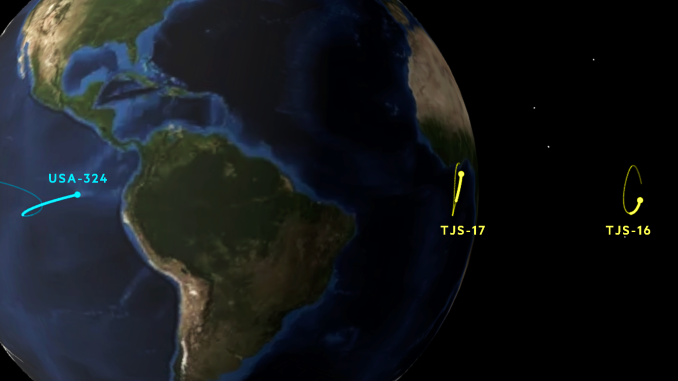
In 2024, five Chinese experimental satellites, three of the Shiyan-24C type and two others called Shijian-6 05A and B, conducted a series of close-range manoeuvres — the behaviour the US likened to dogfighting.
Data from Comspoc, a space analytics company, shows another test in June, when two Chinese satellites took part in a “rendezvous operation” in GEO that may have been the first of its kind.



