
This article is part of our exclusive IEEE Journal Watch series in partnership with IEEE Xplore.
CERN’s Large Hadron Collider (LHC) uses extremely strong magnets to collide particles at nearly the speed of light, breaking them up into smaller components for study. The LHC is already capable of slamming about 60 particles together 40 million times per second in a single experiment, which has led to some of the most important particle physics discoveries of the century.
But scientists at CERN are not stopping there. They are currently working on upgrading the LHC for upcoming experiments scheduled to begin after 2030. The new iteration of the particle collider, called the High-Luminosity LHC, will slam more particles together than before. (The phrase “high luminosity” refers to the increased number of particle collisions.) CERN’s goal is to achieve between 140 and 200 particle collisions 40 million times per second in each experiment in order to increase their chances of observing rare particles or phenomena. To succeed, the collider will need extremely compact and high-quality magnets.
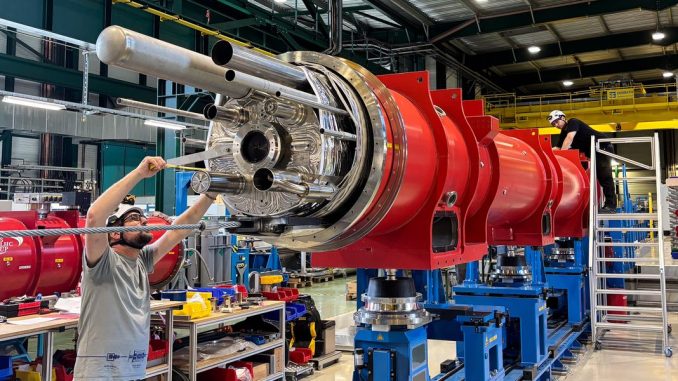
In a study published 24 September in IEEE Transactions on Applied Superconductivity, researchers outline their journey to manufacture these next-generation magnets for the LHC, which require new materials and manufacturing techniques.
Developing Nb₃Sn Superconducting Magnets
The collider’s current dipole magnets contain coils made of niobium and titanium (NbTi) and can achieve strengths of 8.3 tesla. That is about 166,000 times as strong as Earth’s magnetic field. However, this magnetic force is the upper limit of what NbTi coils can achieve. For the LHC’s new quadrupole magnets, scientists are creating coils made of niobium and tin (Nb₃Sn), which will yield just under 12 T.
Susana Izquierdo Bermúdez, a magnet engineer at CERN who leads a team of about 60 people, has been involved in the development of these magnets since 2012. Over the years, she has contributed to many different aspects of the project, including early winding tests, electromagnetic design, mechanical design, manufacturing and testing.
Izquierdo Bermúdez notes that while NbTi is ductile and can be wound after the superconducting compound has been formed, Nb₃Sn is brittle and cannot tolerate the large strains involved in coil winding. For this reason, the magnets are produced using a process known as wind-and-react: The cable is first wound into its final coil geometry, and the Nb₃Sn superconducting phase is formed only afterwards through a high-temperature heat treatment.
To start, the team takes a 760-meter-long cable composed of strands of niobium and tin and wraps it around a center pole to form a coil about 7.2 meters long with a 150 millimeter aperture.
Once wound, the coil undergoes a controlled heat treatment in an inert atmosphere. The temperature is increased over time, plateauing at about 210 °C and then 400 °C before peaking at about 650 °C. During this process, which takes several days, the niobium and tin in the strands react to form the brittle Nb₃Sn superconducting phase.
“After reaction, the coil must be handled very carefully because excessive deformation could damage the brittle superconducting material,” Izquierdo Bermúdez explains.
The coils are then smoothed over with a liquid epoxy resin which fills any internal voids, cracks, or gaps, and finally is cured into a rigid polymer.
In their study, Izquierdo Bermúdez and her colleagues outline their efforts to manufacture more than 120 coils for 4.5 m long magnets and more than 70 coils for 7.2 m long magnets for the LHC. Four coils are incorporated into each quadrupole magnet. .
In total, the team produced 250 coils, 25 of which failed either due to human error or challenges in the manufacturing process that left the coils with subpar electrical or mechanical properties. Izquierdo Bermúdez says that even the smallest imperfection can compromise a coil. In one instance, a coil had to be discarded because a single metal particle trapped between the coil and one of its protective components was suspected of interfering with its performance.
In September, Izquierdo Bermúdez’s team finished running quality control tests on the 7.2 m magnets for CERN, confirming they reached peak magnetic forces of 11.3 T. The magnets are functioning well, and the team is now working to manufacture back ups.
Izquierdo Bermúdez says that it is a great honour and responsibility to be a part of this work, which has been a large team effort. “It has taken many years of work by a large international team, from conductor and magnet development through manufacturing, testing and final integration. Seeing the technology reach this stage is something we can all be very proud of,” she says.
This story was updated on 10 November 2026 to correct the total number of particle collisions in each experiment.
From Your Site Articles
Related Articles Around the Web



Be the first to comment