
Modern battlefields are bathed in radio waves for communications, radar, remote control of drones, and signal jamming to disrupt those functions. The ability to rapidly locate their source could provide considerable tactical advantage, and a new quantum sensor the size of a paperclip promises to work as an “electromagnetic compass” to determine the 3D direction of a wide-range of radio signals.
Pinpointing where a signal comes from normally requires multiple, bulky antennas to triangulate the direction. Each setup is also tuned for a specific frequency, so getting a full picture of the local radio environment requires a considerable amount of hardware. That’s a major limitation on a battlefield, where being large and conspicuous is a significant risk.
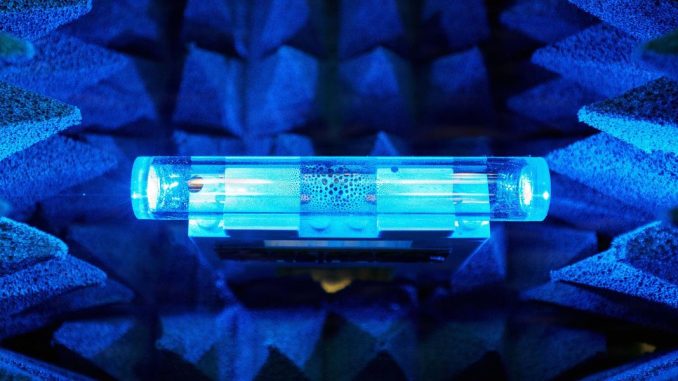
Researchers at the U.S. Army Combat Capabilities Development Command Army Research Laboratory (ARL) have developed a novel quantum sensor that shrinks these capabilities into a single compact device. It relies on a 2.5-centimeter glass chamber filled with excited atoms that can detect a broad range of frequencies and determine the direction of incoming radio waves to within two degrees. The researchers are now working with quantum technology company Infleqtion, in Louisville, Colo., to create a working prototype for use in the field.
“You can imagine having a device that provides you a level of spectrum awareness that’s very difficult to get in a single platform,” says ARL research physicist David Meyer, who is leading the research. “The goal is to get more information, and get that information in the hands of soldiers.”
How quantum sensors detect radio waves
The sensor, described in Physical Review Applied, relies on Rydberg atoms. These are atoms that have had one of their electrons excited to an extremely high energy state, normally by firing a specially tuned laser at them. This forces the negatively-charged electron into a wide orbit of the nucleus, and because it sits so far from the atom’s positively charged core, it is easily perturbed by incoming electric fields, says Meyer. This causes shifts in the atom’s energy levels that can be detected by monitoring the power of a laser shining into the chamber.
Using these atoms to figure out the direction the field is coming from is a little more complicated. Normally, this is done by spacing at least two sensors a significant distance apart and comparing what they pick up, or using an antenna that physically scans around to locate the source. Think of a radar dish in an old World War Two movie, says Meyer.
Instead, the new sensor measures the incoming signal’s polarization—essentially the direction in which its waves oscillate. Many radio signals don’t wiggle up and down neatly on a single plane and instead propagate in a corkscrew-like pattern. This traces either a circle or an ellipse, which sits perpendicular to the direction the wave is traveling. This means figuring out the wave’s polarization can tell you where its source is.
To measure this, the researchers beamed three “reference” radio signals into the device that oscillate along the X, Y, and Z axes. When an external signal hits the device, it boosts the electric field along each axis by a different amount depending on where it’s coming from. This causes an interaction between the reference signals and the incoming signals that is picked up by the atoms and can be used to map out the shape and orientation of the signal’s polarization, and in turn work out where it is coming from.
Instead of using multiple sensors spaced apart to detect where a radio signal is coming from, this device uses a single atom to determine its polarization. DEVCOM Army Research Laboratory
Shrinking the sensor
This ability to measure the direction of a signal using a single, static, and tiny sensor, combined with the broad frequency range of Rydberg atoms, presents a significant advance over existing approaches, says Meyer. Conventional antennae have to be a similar size to the wavelengths they monitor, making them bulky.
You also need several to cover the entire spectrum, but placing them too close together interferes with the signals, because any metal object within an antenna’s wavelength essentially becomes part of it, says Meyer. “So if you want to measure lots of different bands you need lots of different antennas,” he says. “But if you don’t want to separate them by huge amounts, the co-location problem is pretty significant.”
One limitation of the Army researchers’ device is that it only works with circular or elliptical polarization. However, Meyer notes that many signals of interest are already polarized this way, and in the wild linear signals often become slightly elliptical through interaction with the atmosphere. For smaller wavelength signals in the microwave and terahertz range, researchers can also 3D-print a precisely patterned plastic structure known as a wave plate that can polarize incoming signals to make them elliptical, he adds.
A bigger challenge is getting the sensor out of the lab. Experiments so far have run on an optical table in a controlled environment, and the lasers that probe the Rydberg atoms are especially finicky. “The stability required is very high,” says Meyer. “And lasers that are that stable don’t generally like being outside in high humidity and high heat.”
Making a field-ready device with Infleqtion
This is why ARL announced in May a partnership with Infleqtion to develop a field-ready version. Solving the laser stability problem is the biggest challenge, says Seth Caliga, the company’s director of R&D for quantum RF sensing. The gold standard involves optical cavities (arrangements of mirrors often used to focus beams of light) housed in thermally controlled vacuum chambers to protect the lasers from environmental noise, he says, which is clearly impractical in the field.
Instead, Infleqtion plans to piggy back on their optical atomic clock technology, which relies on technology similar to the ARL sensor. In optical atomic clocks the oscillations of a light wave are used for timekeeping, comparable to the swinging pendulum in a grandfather clock. To keep these oscillations stable, they are locked to the precise energy levels in a rubidium atom. (This is possible because electrons only transition between levels when hit with light at a very specific frequency.) The clock is tuned by firing a laser at a cloud of rubidium atoms and adjusting its frequency until the maximum number of atoms jumps an energy level, which signals that the laser’s frequency is locked onto the atom’s transition frequency.
Caliga says the same ultra-stable frequency can act as a kind of “ruler” to stabilize the lasers probing a Rydberg sensor. And because all rubidium atoms are identical, environmental noise affects the clock and the sensor the same way, unlike a classical optical cavity. “It’s not a game of telephone, where there’s frequency errors that go down the chain,” he says. “They’re going to drift together.”
Dealing with that drift remains a significant challenge. By its very nature, a sensor must be exposed to the environment to detect signals, says Caliga. But the highly sensitive atoms can be easily disturbed by heat, humidity, or vibration. This means the device must be continuously re-calibrated, a complex optimization problem Caliga calls “still quite nascent.”
There is also the more prosaic work of miniaturizing the optical and electronic components so it can be packaged more portably, says Meyer. “A lot of this stuff can be extremely shrunk down into absolutely tiny package sizes, so there’s certainly a path there,” he says. “It’s just a very long path with a lot of dollar signs associated with it.”
From Your Site Articles
Related Articles Around the Web



