
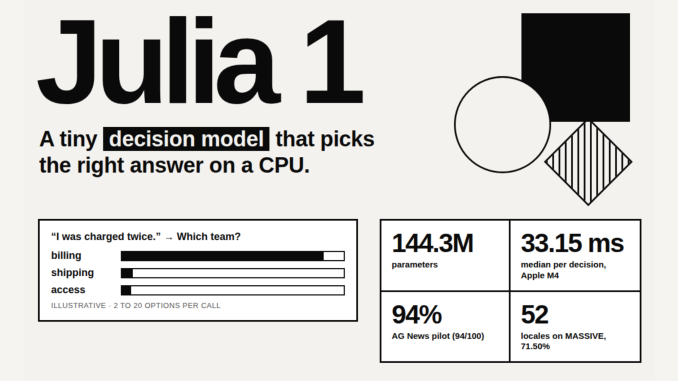
Supersonic Labs, a small AI lab from Brazil, has released Julia 1. It is a compact decision model, not a chatbot. You pass it context, a question, and 2 to 20 candidate answers. It picks one and returns a probability for every option. The model has 144.3M parameters and runs on a plain CPU.
Is it deployable? Yes. The weights are on Hugging Face under Apache 2.0 and run locally with Python 3.11+ on CPU or a BF16-capable GPU. An ONNX build also runs in the browser via WebGPU. A hosted API is announced but not open yet.
What Julia 1 Does
Julia 1 handles three decision types through one API:
choice: pick one label from 2 to 20 described options (classification, routing).
score: return the expected index on an ordered rubric, such as low, medium, high.
noul: return the probability that a yes-or-no statement is true.
Results come back in the caller’s option order with full softmax probabilities. Caller IDs such as billing are returned unchanged. The model does not generate text.
Architecture and Training Budget
Julia 1 starts from JHU CLSP’s mmBERT-small, a 140M-parameter multilingual ModernBERT encoder trained on 1,800+ languages. Supersonic Labs kept the encoder and tokenizer, added a decision head, and trained on decision-format examples. The lab states Julia 1 is not a fine-tuned Qwen model. The runtime supports 8,192 combined tokens, but published benchmarks used a 1,024-token limit.
Total cloud GPU spend for training and experiments was about R$540 (US$104.08). The FP32 weights occupy 550.5 MiB. The private training pipeline is not released. Julia 2, with the lab’s own foundation architecture, is in development.
Benchmark Results
The September 24, 2026 evaluation ran on H200 BF16 with strict encoding. The comparison baseline is TypeSafe’s Jev, using reference values from the Jev benchmark protocol, not a new Jev run.
Typed Decisions: 73.15% (1,463/2,000) vs 72.70% reference.
AG News, 4 labels: 94/100 vs 91% reference.
DAIR Emotion, 6 labels: 86/100 vs 48% reference.
Banking77, 72 labels: 64/100 vs 87% reference. This is the clear failure.
MASSIVE, 18 scenarios: 71.50% macro accuracy across 52 locales; 86.25% pt-PT, 86.75% en-US.
The classification pilots use only 100 examples each. A September 25 CPU run reproduced most numbers: 72.55% on Typed Decisions and 60/100 on Banking77 with 3 abstentions.
On-Device Latency
The lab published per-device measurements. On an Apple M4, one decision per call took a 33.15 ms median. On a Samsung SM-X510 tablet via ONNX Runtime, the median was 203 ms with 393.1 MB peak RSS. On an Intel Core i5-1235U, AG News decisions took a 107.83 ms median. Banking77 took 3,713.54 ms because it narrows 72 labels first.
On X, @supersonicai claims Julia 1 classifies 5x faster than Jev on an i5 laptop. Treat that carefully. The Jev pilot measured Jev as a hosted service called from France, so latencies are not like-for-like.
Interactive Explainer



Be the first to comment