
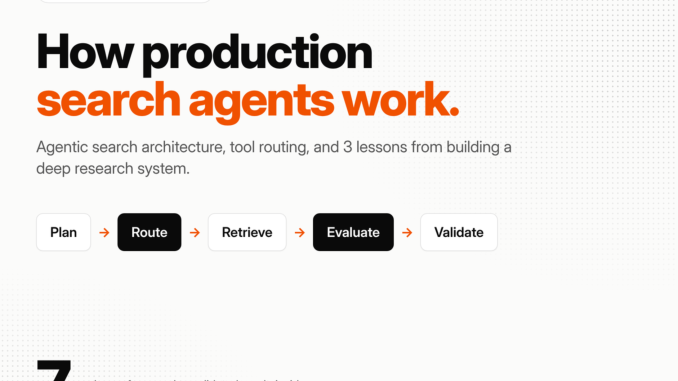
An AI search agent can work in a demo but fail under production workloads when retrieval returns incomplete evidence, retries repeat unsuccessful actions, or execution exceeds time and cost limits. TinyFish, which provides web infrastructure for AI agents, has published two technical guides addressing these challenges. The first defines a production agentic search architecture, while the second shares lessons from building a deep research system. Together, they examine how an autonomous search agent can plan retrieval, evaluate evidence, handle failures, and manage the boundary between model reasoning and deterministic execution.
TL;DR
TinyFish introduced its agentic search architecture and key engineering lessons from building deep research systems. Built on four web primitives (TinySearch, TinyFetch, TinyBrowser, and TinyAgent), the system operates via a seven-phase control loop around the base model. On OpenBenchmarks, TinyFish achieved a 79.0% completion rate on coding tasks while delivering the lowest median task cost ($0.050) and token footprint, highlighting the importance of rigid control loops, failure-specific retries, and unified reasoning over standalone planners.
What is Agentic Search Architecture?
Agentic search architecture enables an AI agent to plan retrieval, access sources, evaluate evidence, and adapt its approach as new information becomes available. The model provides reasoning, while the surrounding application manages state, tool execution, evidence handling, runtime policies, and output validation. Together, these components allow an agent to handle incomplete results, recoverable failures, and changing information requirements.
TinyFish’s architecture draws foundational concepts from a February 2026 architecture preprint, which decouples reasoning from execution through typed tool interfaces. The paper establishes essential system guardrails, including detailed tracing alongside strict caps on tokens, execution time, overall cost, and tool invocations.
How does a production search run work?
TinyFish splits a run into 7 phases:
Define the task: Turn the goal into an “evidence contract”: required fields, sources, freshness and completion rules.
Plan retrieval: Separate independent needs from dependent ones. Dependent queries wait for earlier answers.
Pick the first route: Choose a tool based on what the system knows about the evidence.
Discover, select, retrieve: Treat search results as candidates until the page content arrives.
Evaluate: Label evidence as sufficient, incomplete, conflicting, inaccessible or budget exhausted.
Recover or escalate: Revise the query, retry, change sources or change access method.
Stop and validate: Return completed, incomplete, failed, cancelled or human review required.
Phase 2 addresses a known failure. ChainRAG (ACL 2025) calls it the ‘lost-in-retrieval’ problem, where key entities disappear during multi-hop question decomposition. Phase 6 draws on Search-R1, which demonstrates how models can learn to generate additional search queries during reasoning when earlier retrieval is insufficient. Across 7 QA datasets, its learned multi-turn search beat RAG baselines by 41% (Qwen2.5-7B) and 20% (Qwen2.5-3B).
Routing should follow the information gap, not a fixed ladder.
Escalation is not always the fix. Weak results need a better query. Conflicting sources need stronger evidence. A heavier tool fixes neither.
Retries should be based on the failure type and remain within defined limits. Transient errors may justify repeating a request, while incomplete or conflicting evidence requires a different approach. Browser retries must also account for actions already completed to avoid unintended consequences, such as submitting the same form twice.



Be the first to comment