
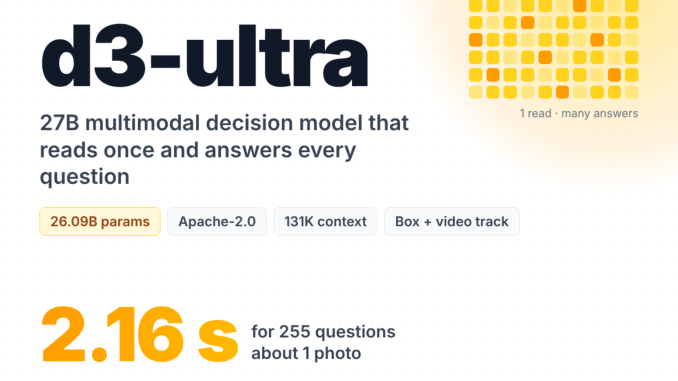
The vLLM Semantic Router team has released d3-ultra, a 27B multimodal decision model under Apache-2.0. The d3-ultra decision model does not generate text. It reads an input once and returns a probability for every answer to every question. For developers, that means routing, classification, visual grounding and video checks from 1 open-weight call.
TL;DR
Size: 26.09B parameters (dense, including a 0.46B vision encoder); 131,072 tokens of context per question.
Runs on: tested on 1 AMD Instinct MI325X with BF16 weights; no official quantized variant is listed yet.
Performance: highest SR-Text score of the 6 decision models in the team’s own private test.
Best: 97.8 on SR-Text tools and automation (chance-corrected accuracy).
Worst: 54.6% on SR-Box (9 domains), 5.0 points below its sibling d3-turbo.
What is d3-ultra?
d3-ultra is a System One decision model from vLLM Semantic Router that answers typed questions with probabilities. It is the newest member of Decision 3.0, a family that spans 0.6B to 27B.
You send a state (text or JSON, plus images or videos) and a set of questions. Each question has a type:
Choice: pick 1 of several options.
Yes / No: return the probability of yes.
Score: rate on a scale.
Box: locate something in an image or a video moment.
Track: follow a target across a whole video.
Images can also sit inside questions and options. A quiz can show a photo, then offer 4 etchings as answers.
How does d3-ultra work?
The core idea is state once. The model reads the input once per request and answers every question from that single read.
The config shows a Qwen3.5-architecture backbone with 64 layers. 48 are linear-attention layers and 16 are full-attention layers. The card does not name its base checkpoint. vLLM’s recipe says the sibling d3 was trained from Qwen3.8-27B.
Box answers always return exactly 1 box with a confidence. A confidence near 0 means the target is not in the picture. Questions over 131,072 tokens fail with max_length_exceeded; nothing is silently truncated.
How does d3-ultra perform on benchmarks?
The research team compares d3-ultra with GLiDE V1.2, d1-ultra, d3-turbo, d3 and Jev 1.14 on 2 in-house tests.
SR-Text has 10,411 text requests with 73,495 questions. Most recreate skills from 34 public benchmarks with new items. Another 4,896 questions come from 43 new task families, like SQL checks and ticket routing. Scores are chance-corrected: 0 is chance, 100 is perfect.
d3-ultra: 87.2
GLiDE V1.2: 85.1
d1-ultra: 83.4
d3-turbo: 83.1
d3: 81.4
Jev 1.14: 73.1
d3-ultra leads every area except arts and human taste. There, d1-ultra scores 90.8 against 89.6, within the margin of error.
SR-Box has 5,678 Box questions on 4,984 images across 10 domains. A box counts as correct at IoU 0.5 or higher. d3-ultra scores 58.2% over 10 domains and 54.6% over 9. d3-turbo scores 60.0% and 59.6%. Jev 1.14 scores 45.7% and 46.9%. The team says d3-turbo stays stronger on natural images, while d3-ultra leads on charts.
Latency: on 1 AMD Instinct MI325X with AutoModel, 1 question about a photo takes 304 ms. 255 questions take 2.16 s, about 7.3 ms per extra question.



Be the first to comment