
Whether voters are alive or dead is of vital interest to democracies. Yet unscrupulous political operators have long voted on behalf of the dead or absent and otherwise committed electoral frauds exploiting the weaknesses of paper identification systems. So some 50 countries now use biometric technologies, such as fingerprint readers or facial recognition technology, at some stage in their elections.
On 4 October, voters in Bosnia and Herzegovina became the latest to join the biometric voting club, the same day Brazil, a pioneer of the technology that now boasts 89 percent biometric enrollment, went to the polls. Despite some technical hiccups, election observers say voting was orderly in both countries. Yet as more countries adopt biometric technologies, experts point to significant drawbacks, including high costs, opaque processes and, in the worst case, fallible technology locking people out of the electoral system.
Bosnia’s biometric voting growing pains
Electoral fraud has long plagued Bosnia, says Hasan Kamenjaković, spokesperson for the Bosnian election-monitoring group Pod Lupom, with people voting multiple times, on behalf of others, or on behalf of the dead, often abetted by partisan polling officers. An out-of-date electoral roll packed with people who have died or emigrated made matters worse, says Tana de Zulueta, head of the Organization for Security and Co-operation in Europe’s (OSCE) election observation mission in Bosnia.
Although Pod Lupom polling found 83.4 percent of the voters it surveyed approved of using biometric technology to tackle fraud, politicians fought its introduction, says Kamenjaković. The country’s High Representative, an official with sweeping powers appointed by the international Peace Implementation Council set up to uphold the 1995 Dayton peace agreement that ended the Bosnian War, had to force through the implementation.
The controversy led to a rushed rollout. OSCE observers reported technical problems with biometric devices at 13 percent of observed polling stations, as well as late openings and procedural slip-ups which they blamed on hasty training of polling staff. Observers also noted problems with ballot secrecy, due to cramped polling stations and poll workers often positioned next to the ballot scanners, and family members joining voters in the booth. But both OSCE and Pod Lupom said election day went relatively smoothly. Bosnia’s ID agency IDDEEA reported a biometric identification success rate “exceeding 97 percent” in preliminary data.
The most significant outcome, says Kamenjaković, was a record-low turnout of 42.02 percent, down from 51.45 percent at the previous election. While hard to verify, he sees it as a clear sign that the technology prevented fraudulent votes, an assessment de Zulueta agrees with. “We now think that this is the real turnout here in Bosnia and Herzegovina,” says Kamenjaković.
Despite those gains, biometric voting technology tackles only a narrow set of problems on the day. Vote buying, disinformation, workplace pressure and misuse of public resources to promote political parties remained rife in the run-up, says Kamenjaković. “We saw so many election irregularities in the pre-election period,” he says. “That’s why we say we are only halfway there.”
In this environment, technology itself can become a source of mistrust without careful handling, says de Zulueta. The election commission leaned heavily on Smartmatic, a British election systems company, to build and run the system, but published neither pre-election test results nor data-handling rules before the vote. “That sort of omission leaves you open to challenges and allegations, and indeed external interference,” says de Zulueta.
Lessons from more experienced countries
Transparency and trust are a core concern around biometric election technology. In Brazil, the Superior Electoral Court (TSE) introduced biometrics to tackle similar problems, in particular poll workers voting on behalf of absentee voters. Voters’ fingerprints are checked against rolls using a machine built by TSE before they can vote. If verification fails, poll workers can override the system after a manual identity check, but must scan their own fingerprint, creating a log that can flag irregularities.
However, the TSE has never open-sourced the code behind its election technology, despite saying it would in 2018. It does hold annual hackathons that let security researchers probe the software, but these take place in restrictive, time-limited settings, says Diego Aranha, a security researcher at Aarhus University in Denmark. Despite those limits in both 2012 and 2017, Aranha’s team showed it could reverse a randomization process designed to protect voter anonymity. And crucially, the biometric scanner itself has never been within the scope of testing.
These problems are exacerbated by the fact that Brazil’s voting system has no paper ballots, so “what the software says becomes ground truth,” says Aranha. Because the electoral court writes the software, runs the elections and oversees its own checks, there is “an inherent conflict of interest,” he adds. And opacity can feed disinformation. On election night, a temporary freeze in the publication of results that the TSE attributed to data processing bottlenecks prompted claims of manipulation.
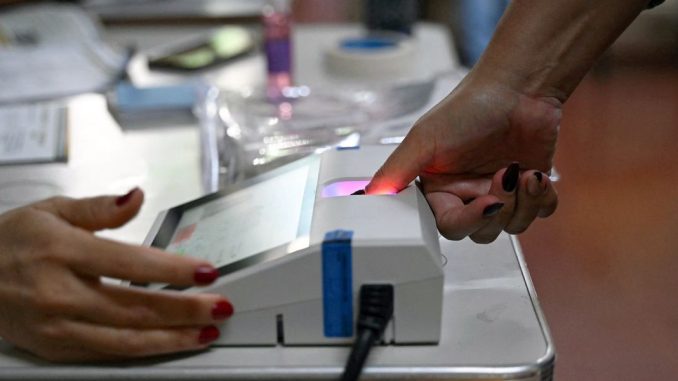
A voter verifies her identity with her fingerprint in Laktasi, Bosnia and Herzogina on 4 October 2026.AFP/Getty Images
Biometrics are also never 100 percent accurate. Bosnia and Brazil have reliable backups for voters who can’t verify their identity, but elsewhere authentication failures have unfairly disenfranchised people. Nigeria used biometric technology in elections ahead of its 2023 elections, when fingerprints collected during registration were used to purge duplicate entries from the electoral roll. Roughly 10 million of 80 million registrations were canceled, says Steve Adeshina, a professor of computer engineering at Nile University of Nigeria, who led the drive as then-director of ICT at the country’s Independent National Electoral Commission (INEC).
But in 2021, INEC began using a handheld device that uses fingerprints and facial scans to authenticate voters at polling stations barring voters after three failed attempts. In recent governorship elections in Ekiti and Osun, there were multiple reports of voters being turned away, with domestic observer Yiaga Africa finding instances at 11 percent of polling stations it observed in the Osun state election.
It’s unclear how many were wrongly turned away. But Adeshina notes that faces change with age, and both aging and manual work can alter fingerprints, a concern in a heavily agricultural country. Given Nigeria’s history of widespread voting irregularities, however, he says the risks may be acceptable if the technology removes the possibility of people manipulating the vote. “My attitude to technology is create a monster that you cannot control, so even if somebody puts a gun to your head there’s nothing you can do,” says Adeshina.
However, Nic Cheeseman, a professor of democracy at the University of Birmingham in the UK, says the idea that voting technology removes the human factor from elections is a myth. People still set up and run the systems. And the places most likely to adopt the technology are those with the most disputed elections, he says, usually due to distrust in the electoral commission – the same body that has to operate the technology. “Technology works best where you need it least,” says Cheeseman.
That’s not to say biometrics have no place in elections, says Cheeseman. Using them to clear “ghost voters” off electoral rolls is cost-effective and avoids the logistical challenge of verifying every voter on election day. But using biometrics for voter authentication on election day is not cheap, he adds, and often comes at the expense of more effective investments like nonpartisan election observers and civic education.
That echoes de Zulueta’s concerns about Bosnia’s roughly €38 million system. “It’s going to require levels of attention and institutional structures they simply do not have yet.”
Despite those limits, or perhaps if electoral commissions can take the limits into account, biometric technology still has value to offer, says Kamenjaković, of the Bosnian election-monitoring group Pod Lupom: “At least in this period in the development of the democracy of Bosnia and Herzegovina, it is worth it to take the risk, because we really needed a step forward in strengthening that electoral integrity and also democracy.”
From Your Site Articles
Related Articles Around the Web



Be the first to comment